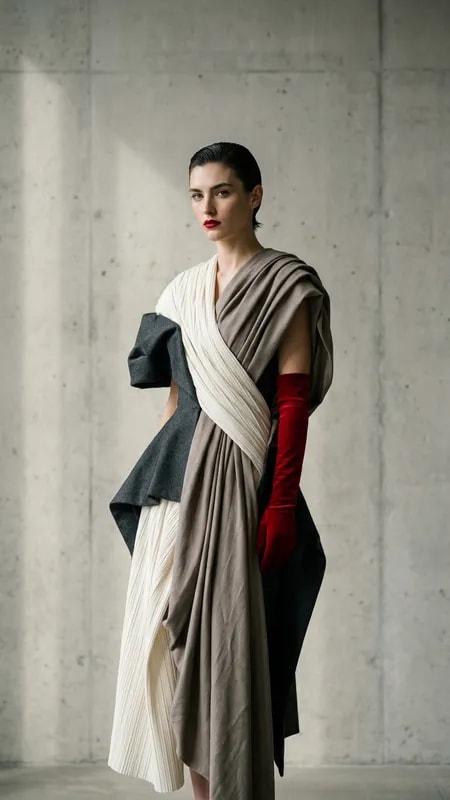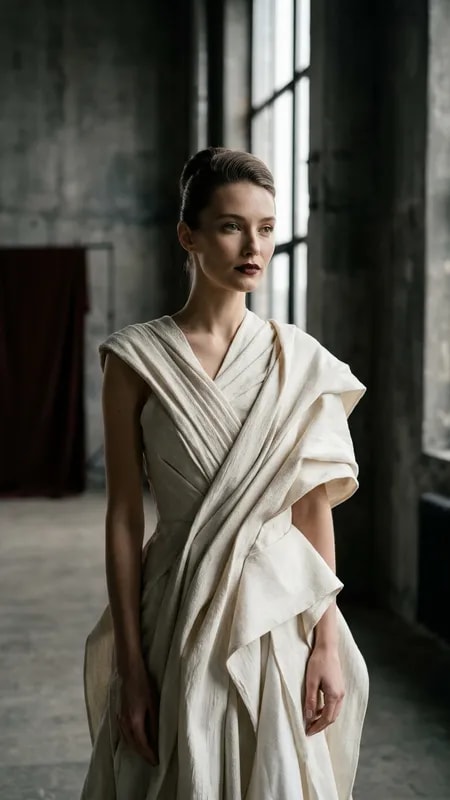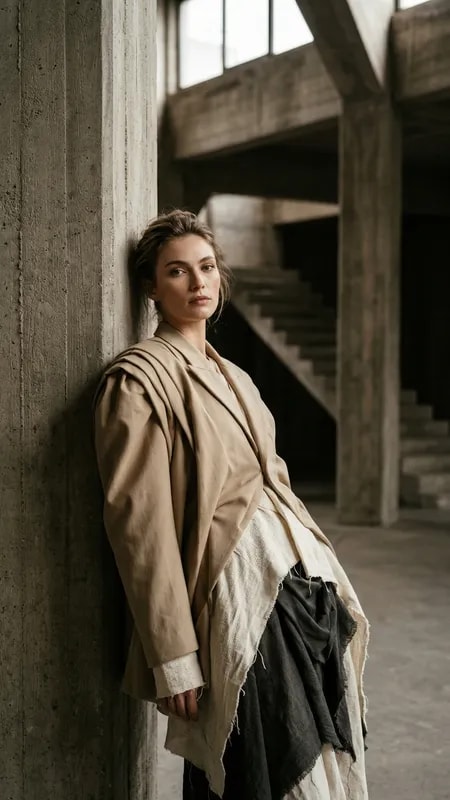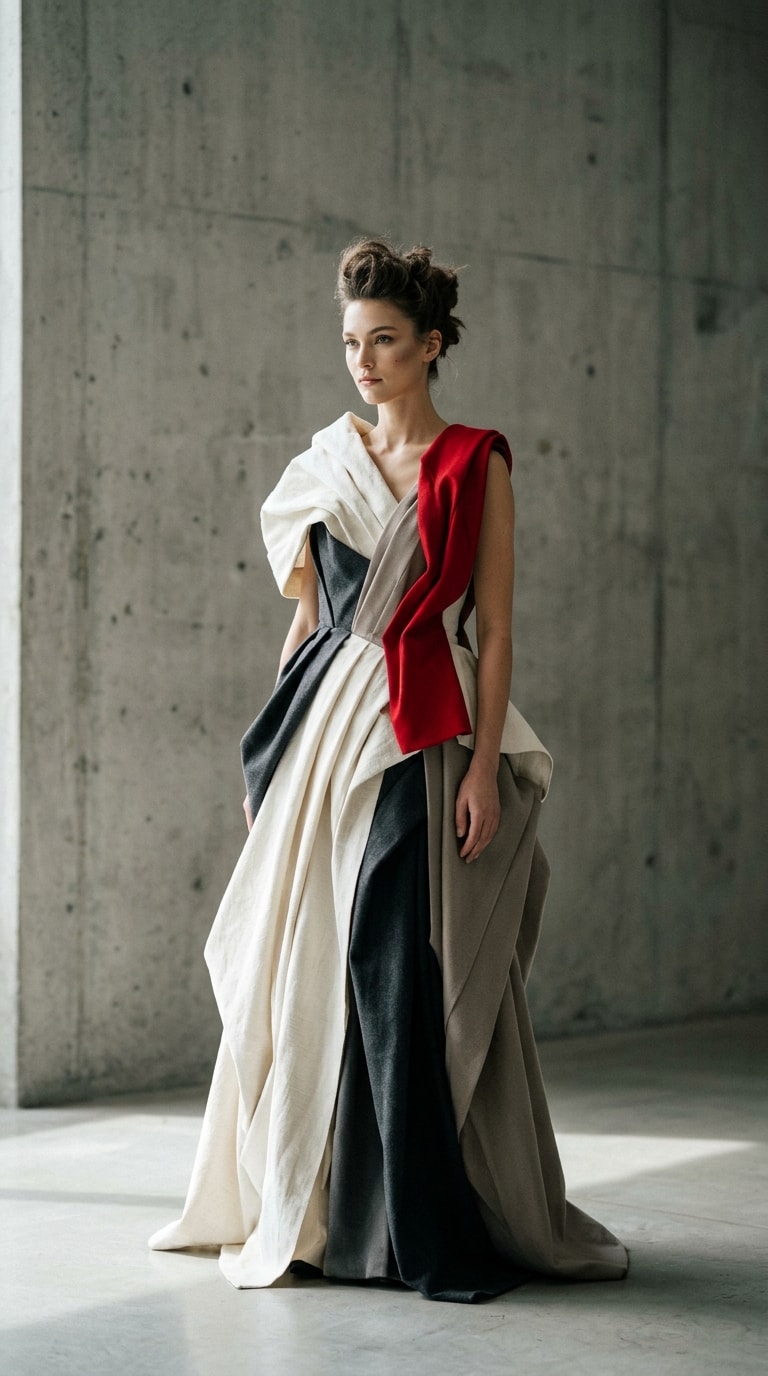
She stands dead center in a room of unfinished concrete, and the wall does most of the styling work for her. The model is framed head to floor with air on both sides, and that generous negative space is what makes the gown read as an object rather than an outfit. Cream and beige folds pile and spill around her, a black panel cuts down the middle like a seam between two ideas, and a single red accent crosses the bodice with the crispness of a brushstroke. Her hair is swept up, her gaze level and unhurried, and nothing in her posture asks for attention.
What makes the look work is the way the dress behaves like built structure. The draping is soft, but the volume is deliberate: gathered weight at the hip, a column of dark fabric anchoring the center, edges that catch the air instead of clinging. Against a flat gray backdrop, those layered folds become the only texture worth following, so the eye travels upward from hem to shoulder in one slow line. This is the argument for photographing avant-garde clothing in bare industrial space — when the set offers nothing decorative, the garment's silhouette has to carry the entire composition, and here it does.
Light does the rest. Soft directional daylight arrives from the left, skimming the fabric so the weave and the folds register as separate things, then falling off into gentle shadow on the right side of the frame. The palette stays disciplined — cream, beige, charcoal, a muted red, cool gray — which keeps the image quiet and slightly austere rather than theatrical. There is a medium-format clarity to the rendering, the kind of clean 85mm-like perspective that flatters a full-length pose without distorting proportion. A viewer feels hushed rather than dazzled, which is exactly the mood a muse page should leave behind.
And the muse herself is doing something subtler than modeling. Her calm, slightly distant expression gives the picture its interior life; she looks past the lens rather than into it, as though the dress is the subject and she is its keeper. That restraint is the difference between a catalog shot and an editorial portrait. The stillness reads as confidence, and confidence is what makes a sculptural gown look wearable in the imagination.
For anyone building a similar page, the recipe is repeatable: find a hard, unadorned surface, place your figure centrally, leave room around the silhouette, and let one soft light source from the side do the describing. Skip the props. Let the drape be the drama, and give the woman in it enough quiet to hold the frame.