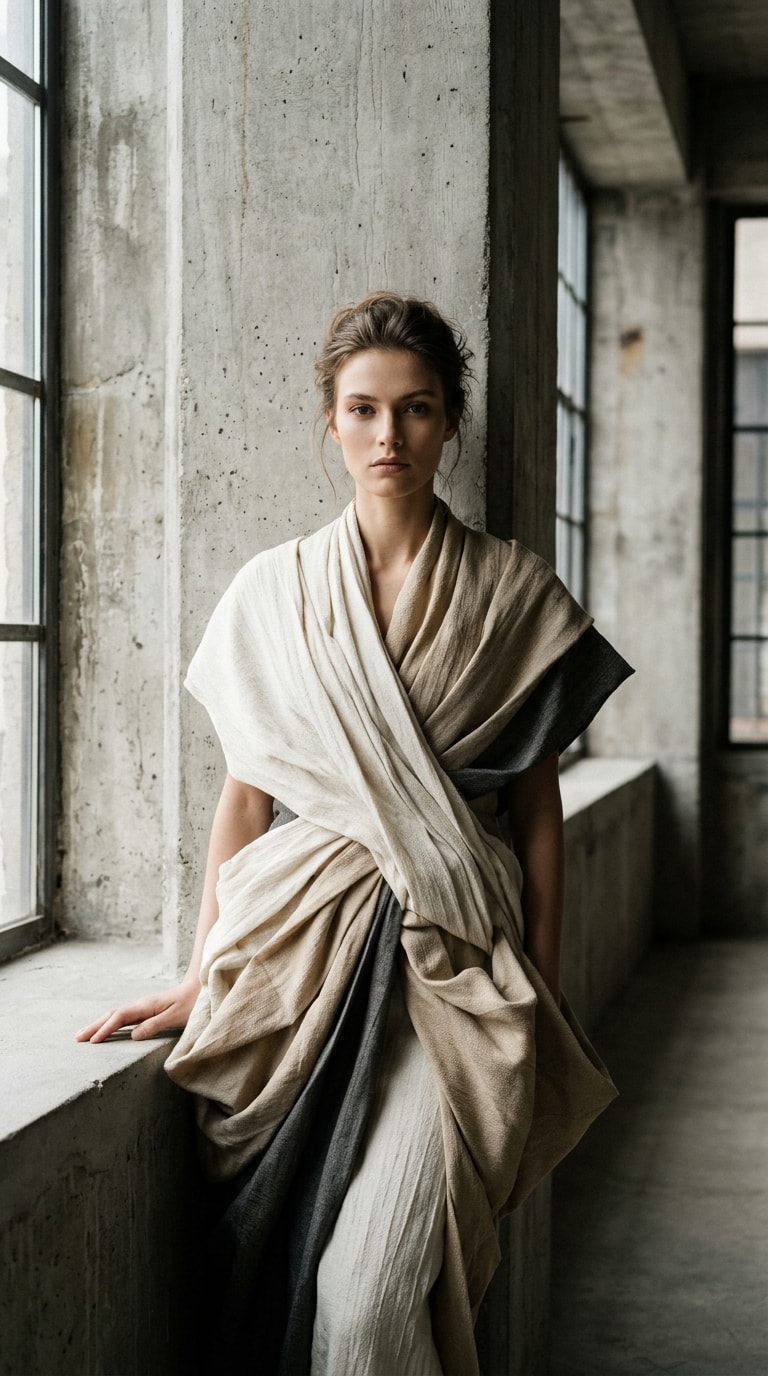
There is a particular kind of confidence in a model who does not need to move. In this frame she stands almost perfectly still beside a concrete ledge, hands settled, chin level, and the whole room organizes itself around her. The vertical crop keeps her from mid-thigh to just above the head, and the windows and pillars fan out on either side like an audience that has agreed to stay quiet. Nothing in the composition competes with her; everything points back to the center.
The garment earns that stillness. Cream, sand, and charcoal fabric wrap and cross the torso in heavy diagonal bands, gathering at the shoulder and releasing into long folds that fall with real weight. This is clothing built like architecture, with edges that hold their shape and a drape that behaves differently from every angle. Against raw concrete, the softness reads as luxury without ornament. The restrained palette does the rest: cool gray walls, warm neutrals on the body, a deep slate shadow tucked into the folds.
Light is the second collaborator. Daylight comes in from the left, diffused by the tall multi-pane windows, and it lands gently on her cheek and along the ridge of the fabric. There is no glare, no hard rim, just enough direction to describe texture and enough softness to keep the mood calm. The lens choice feels equally considered, an intimate portrait focal length that keeps proportions honest and lets the background fall away gradually rather than disappearing. You can read the weave of the cloth and still sense the scale of the room behind her.
What makes this useful as a portfolio image is how much it says with so little. It demonstrates an ability to hold a frame, to wear volume without being swallowed by it, and to work with a space that has not been dressed or polished. Unfinished interiors are unforgiving; they expose posture, timing, and whether a model understands where the light is coming from. Here the answer is clear in the steadiness of her gaze and the way the fabric settles exactly where it should.
For a book, this is the quiet anchor rather than the opener. It shows range beyond drama and proves the muse can carry a page through presence alone. The mood it leaves is calm and slightly awed, the feeling of standing in a large empty room and noticing that one figure has made it feel complete.