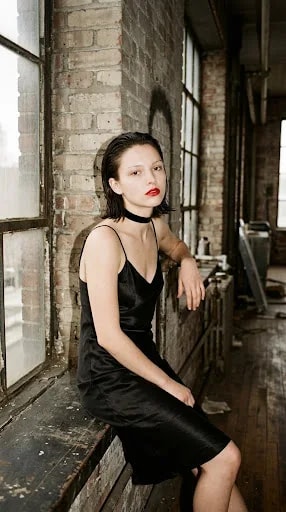
There is a particular kind of photograph that could only have been taken in a certain decade and a certain kind of room. The room has exposed brick, windows too tall for the ceiling height, a radiator that clanks through the winter, and a floor that has never once been polished. The person in it is sitting on a wooden ledge as if she has been there for an hour and might stay for another, one shoulder turned toward the light, a black satin slip dress falling in a clean line, a thick choker sitting exactly where a necklace should not. Nothing about the picture is styled to look styled. That is the whole trick.
The loft was the era's most reliable co-star. Rent was cheap in the industrial districts of any city with abandoned warehouses, and the people who moved in painted nothing, sanded nothing, and hung a single bulb. What they got in return was scale and texture: brick that softened every shadow, windows that gave the light something to do all afternoon, and a permanent sense of being slightly outside the rules. Fashion photography noticed. So did the designers, who started cutting slip dresses and bias skirts that looked best against something raw and unfinished. The contrast was the point. A delicate garment in a hard room reads as confidence, not fragility.
The beauty here is deliberately minimal and deliberately imperfect. A short bob, blunt and dark, cut to hit the jaw rather than the collarbone, so the neck and the choker do all the decoration. Skin left mostly bare except for a red lip that is the only saturated color in the frame. The lip is not a small decision; against warm browns and grays it becomes the focal point, pulling the eye up from the dress and giving the whole image a pulse. Hair slightly slept-on, liner slightly smudged, no highlighter in sight. The look says she got dressed in four minutes and meant every second of it.
What makes the image linger is the detachment. She is not performing for the camera so much as tolerating it, which is the entire emotional register of the decade's best style muses. Grunge taught a generation that visible effort was the enemy, and the loft photograph is where that lesson became visual: soft natural light, slight film grain, a vertical frame that lets the window panes crop the subject instead of centering her. She sits off to one side, and the architecture gets equal billing.
You can recreate the mood without the warehouse. Find a wall with some history, shoot near a window in the late afternoon, and let the light fall from one side only. Choose one strong garment, one strong color, and skip everything else. Then stop adjusting. The 90s muse was never the best-dressed person in the room; she was the one who looked like she had somewhere better to be and hadn't decided yet whether to go.