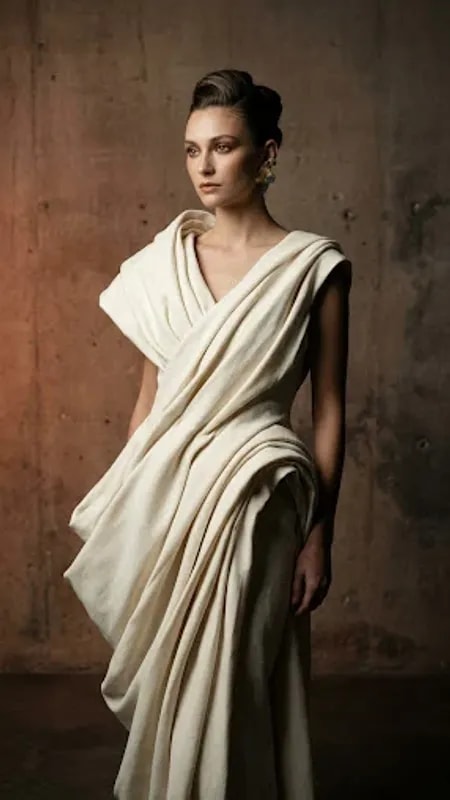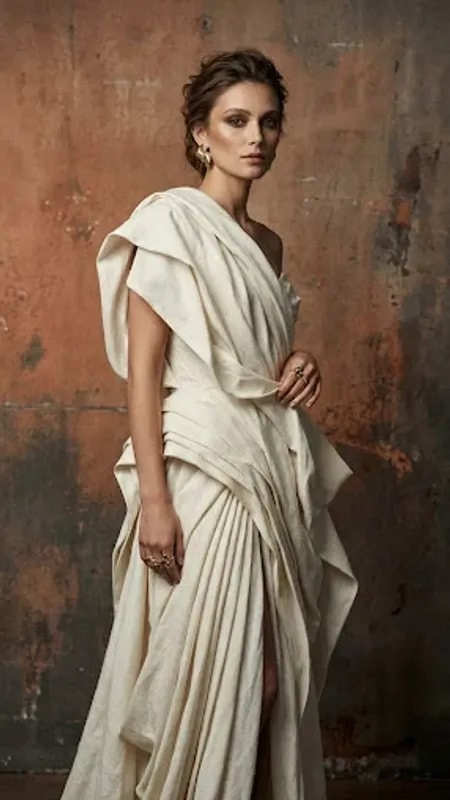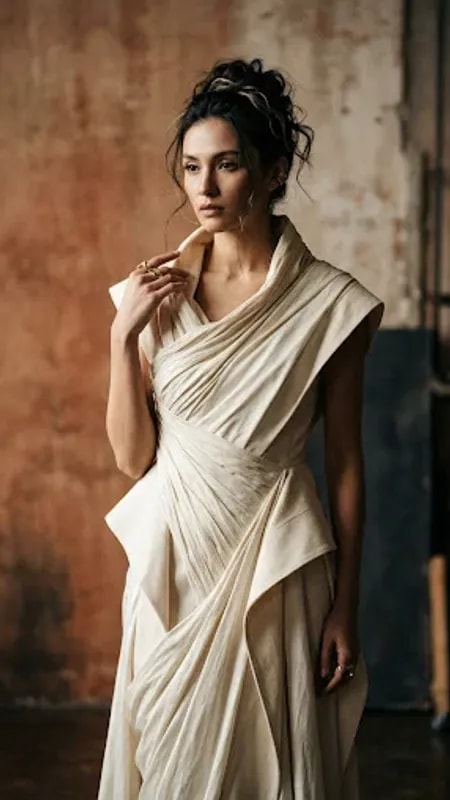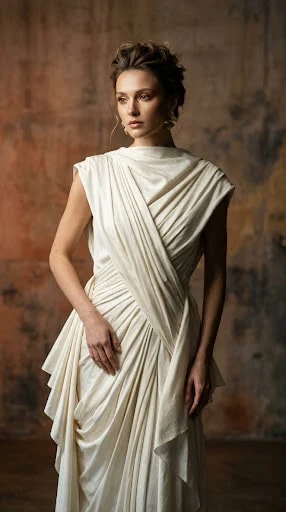
Most muse fashion photography chases softness. This frame does the opposite and hands the whole picture to one hard source of light coming in from the left, close enough and low enough to carve rather than flatter. The result reads less like a lookbook and more like a canvas pulled off a chapel wall. Every fold of the ivory gown becomes a ridge, every ridge throws a shadow, and the shadow becomes as much a part of the design as the silk itself.
The backdrop earns its place in that equation. Rust, burnt orange, and slate bleed through a heavily mottled wall like old pigment that never fully dried, and the camera's fast portrait lens softens it just enough to keep it atmospheric instead of busy. That blur matters: it holds the wall at the distance of a painted sky while the model's jawline, the stitched edge of the draping, and the faint sheen along her shoulder stay razor-sharp. Warm ground, cool ivory, one diagonal of fabric cutting across the middle of the frame — the composition resolves in a single glance, then rewards a second and third look.
The styling leans classical without tipping into costume. The gown's asymmetrical draping borrows the logic of Grecian statuary — weight gathered on one side, fabric released on the other — but the finish is modern, clean, and precisely fitted. Her gaze goes off-camera with a stillness that reads as composure rather than vacancy, the expression of someone who has stood in this light long enough to forget the camera exists. That is the hardest thing to direct and the easiest thing to ruin.
For photographers chasing the same mood, the lesson is technical before it is poetic. Position the key light so it skims the subject at roughly ninety degrees, then let the shadow side fall into near-black rather than filling it. Expose for the lit shoulder and accept that a third of the frame will go dark. Choose a textured wall in the same warm family as the skin, and open the aperture wide enough to turn its mottling into atmosphere. Chiaroscuro is not a filter or a grade; it is a decision about where darkness is allowed to live.
What lingers is the paradox at the center of the image: a contemporary fashion photograph that feels centuries old, an ivory column of fabric standing against a wall the color of weathered clay, and a face lit as though someone had just struck a match off-frame. The muse here is not an accessory to the clothes or the set. She is the light's collaborator, holding still while it does its work.