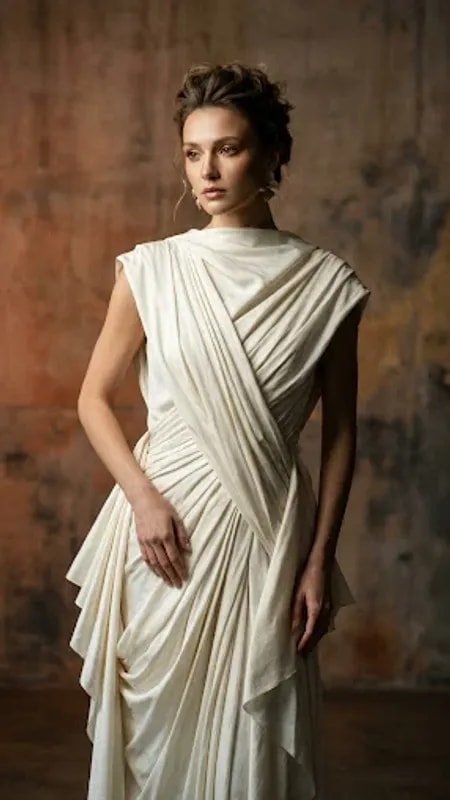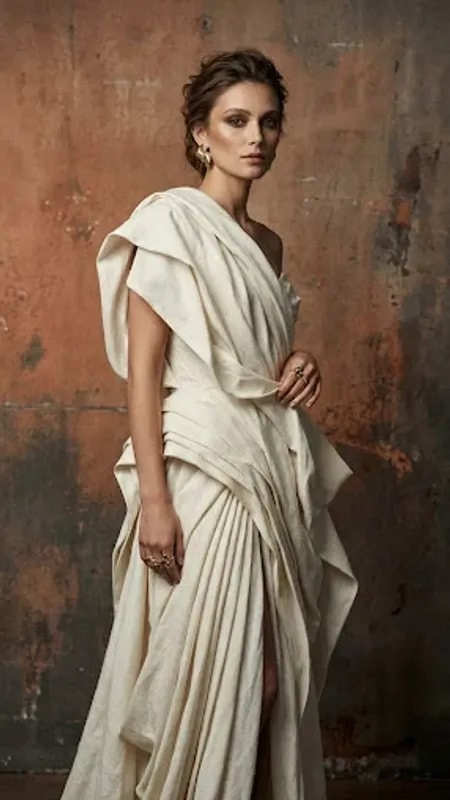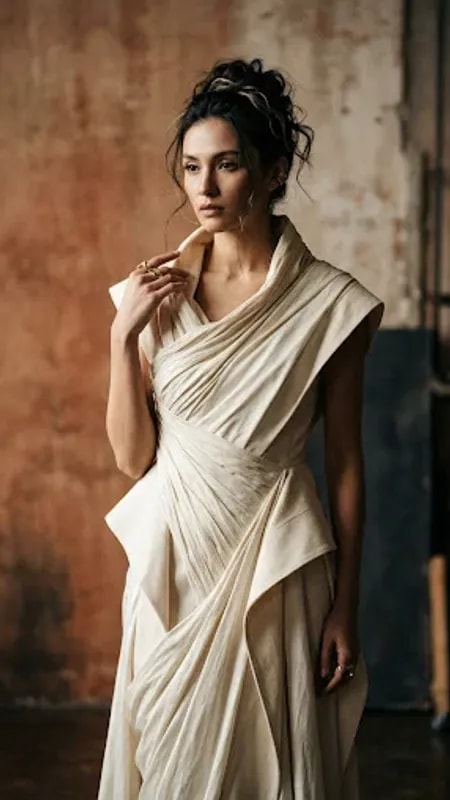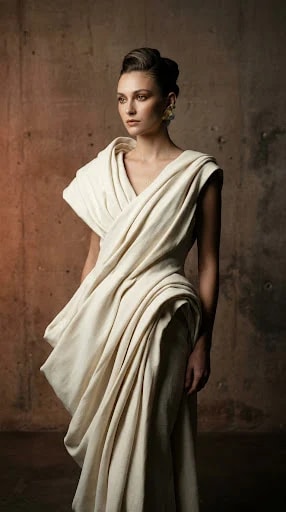
The wall deserves credit as a co-author. Bare, troweled concrete in a deep rust tone gives the portrait its temperature before the model even registers — an earthen backdrop that would swallow a lesser garment whole. Against it, the cream dress reads as light made solid. Ivory on terracotta is an old pairing, the same chord struck in frescoes and village pottery, and it works here because neither side apologizes: the wall stays rough, the fabric stays immaculate.
What holds the composition together is a single diagonal. The gown's asymmetrical draping loads weight onto one shoulder and sweeps the excess across the body, drawing a long slanted line from collarbone to hip. Diagonals are restless by nature; they imply motion and slight instability. This one is disciplined by two vertical anchors — the column of the neck and the severe, tight bun — so the picture feels charged rather than off-balance. The result is a silhouette that looks carved, not sewn.
Light does the sculpting. A soft directional source rakes across the fabric, deepening the folds until they read like charcoal shading, while the far side of the frame falls into painterly shadow. That is classical chiaroscuro translated into earth tones, and it flatters this kind of textile enormously: heavy drape without strong directional light just becomes a pale mass. The gold drop earrings matter more than their size suggests. They are the only hard, reflective element in a scene of soft matte surfaces, a glint that catches the eye near the face and keeps attention where the mood lives — in that calm, off-camera gaze.
For anyone building a similar image, the discipline is subtraction. One garment with real volume, one textured wall, one light. Resist pattern, resist a second color story, resist props. Shoot at eighty-five millimeters or on medium format and open the aperture enough to soften the concrete behind the model, so texture stays suggestive instead of busy. Center the subject and let the sweep of cloth break the symmetry. Style the hair close to the head so the dress owns all the width in the frame.
Muse portraiture often mistakes ornament for presence. This picture argues the opposite: presence is stillness, structure, and a palette kept to three warm notes. The dress moves, the wall endures, and the model simply stands — which is exactly why you keep looking.