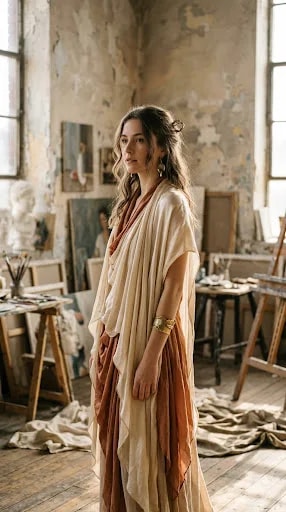
There is a particular kind of dressing that seems to happen in artist studios rather than in front of mirrors. You see it in the woman standing among easels and half-finished canvases: fabric wrapped rather than tailored, one shoulder bare, a sweep of cream falling against a rust-toned panel like a brushstroke that stopped exactly where it should. Nothing about the outfit looks purchased as a set. It looks assembled, the way a painting is assembled, with each element added because it answered something already on the surface. That is the real logic of muse style — not nostalgia for someone else's bohemia, but the confidence to treat getting dressed as composition.
The palette carries most of the mood. Warm chalk whites, unbleached cream, faded terracotta, and the brownish red of old brick keep the whole look inside a single weathered key, which is why it reads as calm rather than busy. Fabrics matter as much as color: raw silk with a slight slub, gauzy cotton that holds a crease, linen that wrinkles honestly and looks better for it. Shiny synthetics break the spell instantly. If you are building this wardrobe, choose cloth that photographs like texture rather than surface — something the eye wants to touch before it reads the shape.
Shape is where the drama belongs, and it should be singular. An asymmetrical drape across the bodice, a hem that dips lower on one side, a sleeve that gathers at the wrist while the other stays bare — these are gestures, and one per outfit is enough. The fabric should move with the body rather than hold it, so favor wraps, bias cuts, and pieces you can pin or knot into place at home. Layer a rust paneled skirt over a cream slip, or take a long gauzy scarf and drape it once over the shoulder, letting the tail hang loose. The silhouette you want is off-balance in a way that looks intentional from every angle.
Finish with restraint. Hair loose and wavy, skin barely done, a single piece of worn metal at the throat. Let the background do the rest of the work — peeling plaster, aged wood, a plaster bust on a cluttered table. Muse fashion style is finally less about acquiring clothes than about trusting your eye, dressing in the same spirit you would arrange a still life: warm, unhurried, and edited down to the one detail that makes everything else feel alive.