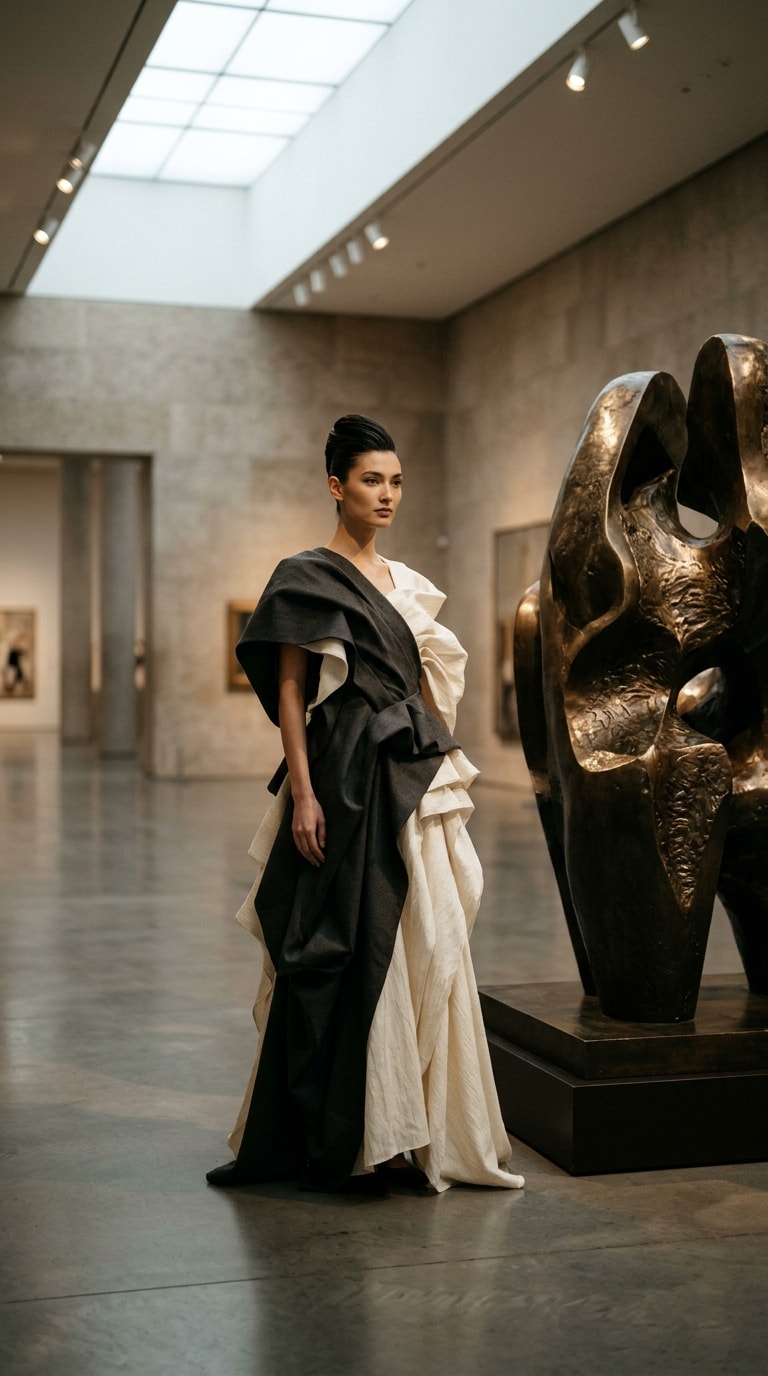
A model in a black-and-white gown does not stand next to the bronze sculpture so much as she negotiates with it. The sculpture rises on its dark plinth like a fixed fact, all mass and age, while the dress answers with movement: cream fabric billowing at the hem, charcoal panels cutting across the bodice, a silhouette built from curves rather than weight. She is placed just left of center, and that slight offset is the whole argument of the picture. Center her and she competes; shift her off-axis and she holds her own ground while the bronze keeps the right side of the frame.
The vertical format does most of the heavy lifting. Above both figures, pale stone wall and skylight open into a wide band of nothing, and that emptiness is not wasted space — it is the pressure that makes the two forms feel monumental. The distant doorway and the framed works on the far wall sit small and quiet, giving the eye somewhere to drift without stealing attention. Polished concrete underfoot picks up a soft reflection of the plinth, doubling the sculpture's gravity while keeping the model's white hem luminous against the gray.
Light behaves like a curator here. Skylight diffuses from above, flattening the gallery into a restrained glow, while track spots pick out the bronze's warm ridges and graze the model's face and shoulder. The result is a palette with almost no color to hide behind: ivory, black, cool gray, and the amber of patinated metal. Those warm highlights on the sculpture matter, because they keep the bronze from reading as a dark void beside the dress. Instead, the two subjects share a temperature and separate on texture — polished, weathered, matte, fluid.
What makes the frame feel like an editorial rather than a documentation shot is the stillness between the two forms. The model's posture is poised but unforced, chin level, arms relaxed, as if she has been standing there long enough to become part of the collection. Nothing in the image rushes. The composition seems to ask a simple question and then refuse to answer it: which one is the artwork, and which one is the visitor?
For anyone shooting fashion in a museum, the lesson is scale management. Let the architecture breathe, let the art keep its plinth, and place the figure where the negative space can do the framing. A gown this sculptural can survive beside a monument — but only if the photographer resists the urge to fill the room.