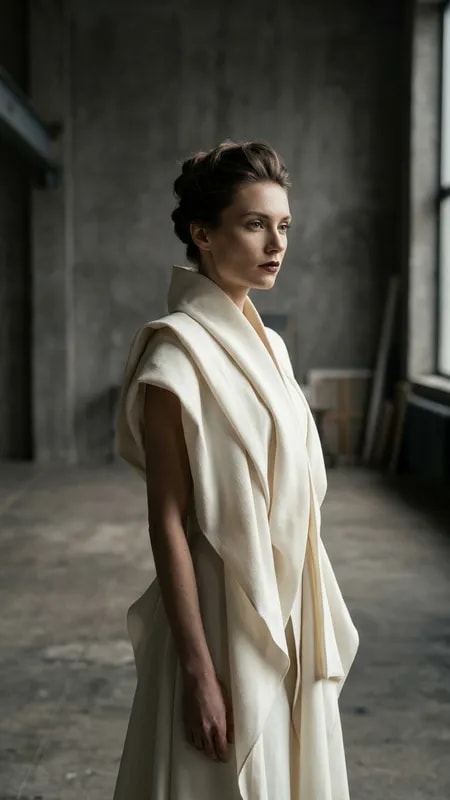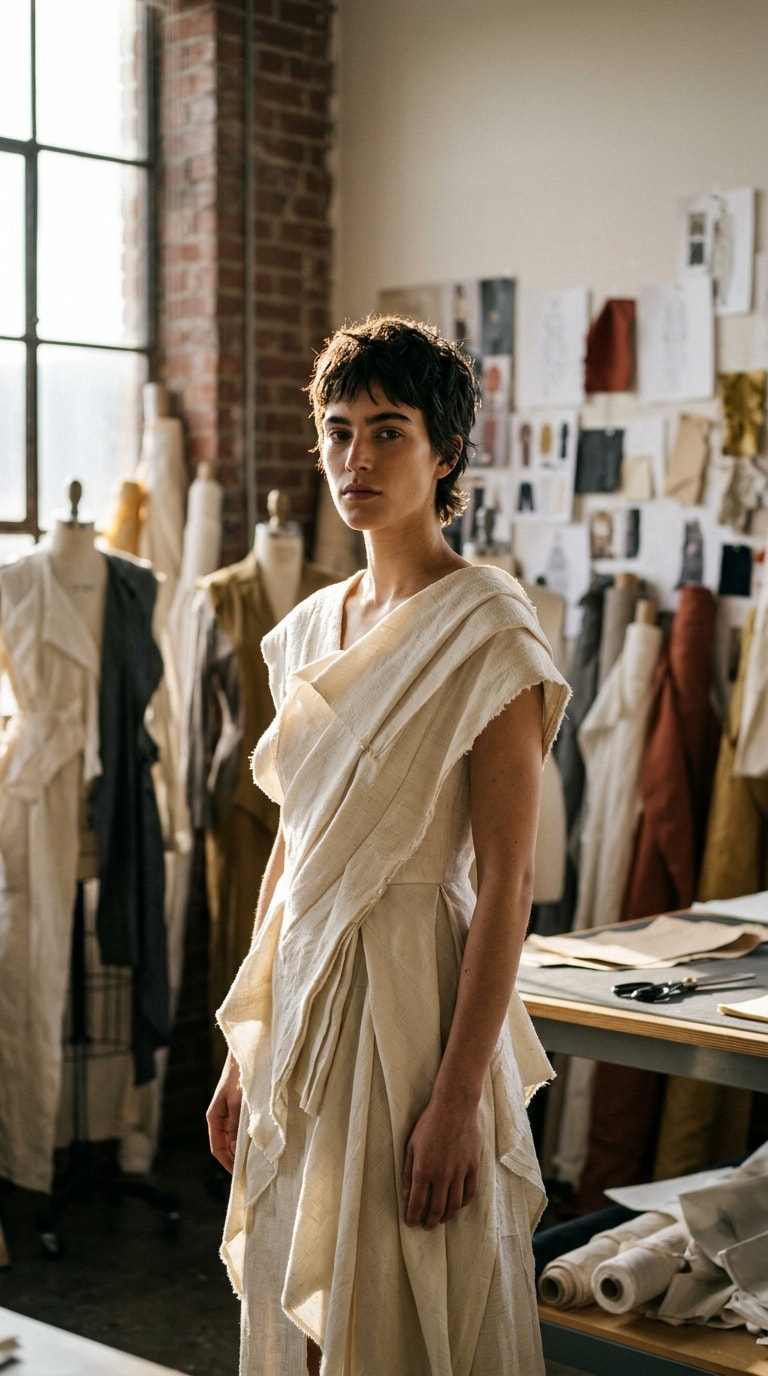
The garment has no hem. The edges are frayed, cut on a bias and left to do whatever they want. She wears it anyway, standing square in the window light with her hands loose at her sides, and the effect is not unfinished but deliberate. Behind her, a dress form holds a half-pinned muslin, and a worktable carries shears, a paper pattern, a scatter of chalk. Nothing in this room is complete. Everything in this room is being decided.
A muse is often described as a passive thing — a face, a mood, an excuse. Look closer at how this portrait works and that reading falls apart. The garment only becomes a garment once it moves on a body that refuses to stand like a mannequin. She has shifted her weight, turned her shoulder, let one sleeve hang where the pattern never intended. The designer will see that shift and cut for it. Inspiration is not a lightning strike; it is a person testing the cloth and reporting back.
The raw edge is the argument here. Finished hems hide the thinking. A loose thread admits it. In ateliers where clothes are built rather than assembled, the unfinished state is a stage of confidence, not embarrassment — the moment when the fabric has enough structure to hold a shape and enough freedom to still change. That is why the muslin on the form behind her matters as much as the garment on her shoulders. Both are drafts. Both are honest.
Her expression carries the whole photograph. She is not performing for the camera, not softening her jaw or tilting her chin into something more flattering. The cropped hair, the direct eyes, the total absence of charm — this is the look of someone who has been in fittings long enough to stop being polite about them. A muse with opinions is more useful than a muse with patience. The best work in this room will come from a disagreement, not a compliment.
What the image really records is a working relationship, one that happens in ordinary daylight rather than in a studio flash. The brick, the industrial window, the worn wood — none of it is styled to impress. A designer returns to this room each morning because a particular person keeps showing up in it, wearing whatever is half made and making it mean something. That is the whole mechanism of a collection, and it has never once looked glamorous from the inside.