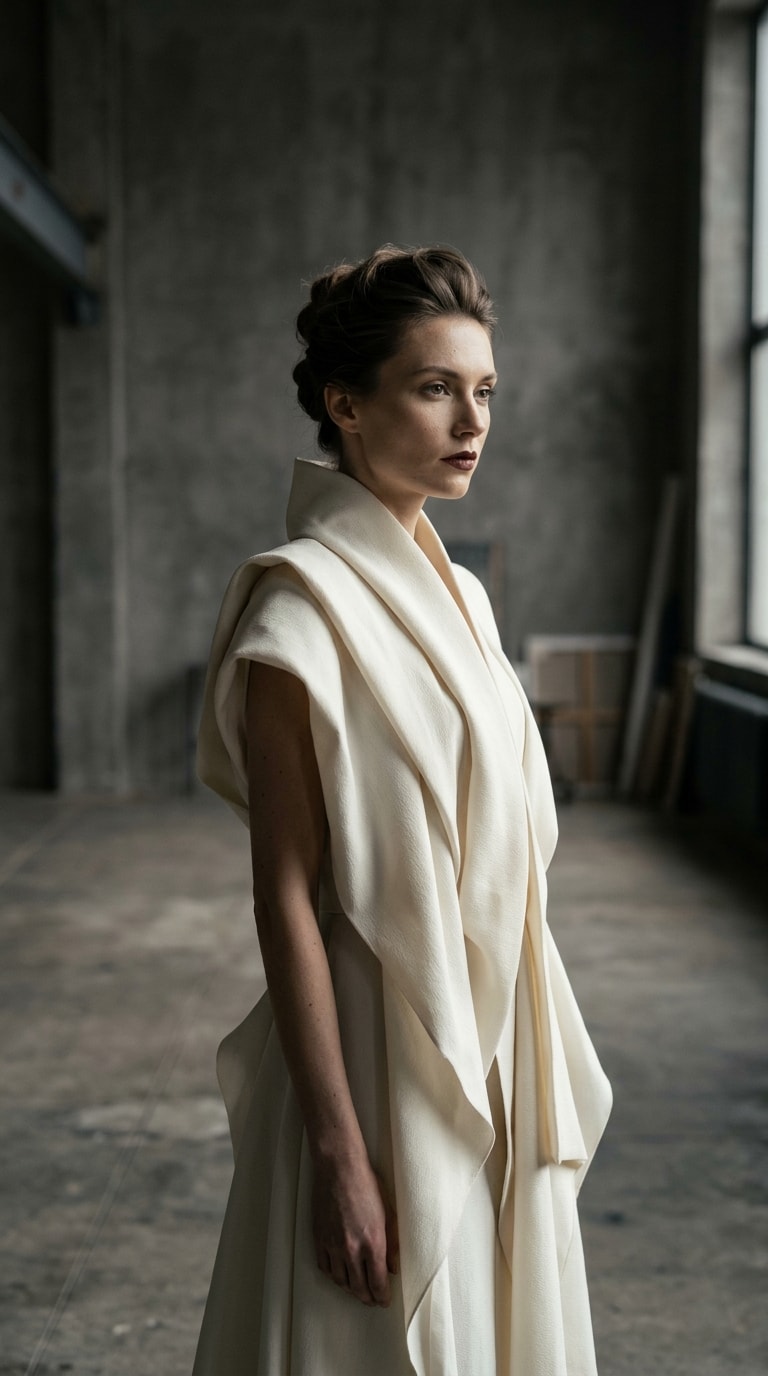
The subject of this portrait is not looking at us. Her chin lifts slightly to the right, past the edge of the frame, and her attention leaves with it. That small act of refusal, the decision not to meet the lens, is what gives the picture its pull. She is placed just off centre in a vertical crop that ends around the waist, so the composition feels less like a pose and more like a moment caught mid-thought. The hair, swept into a textured updo, keeps the silhouette clean and lets the eye travel where hers has already gone.
What she wears does the structural work. A high collar rises to frame the jaw, and from there the cream fabric cascades in folds that read almost like carved stone, soft rather than crisp, catching light on the outer ridges and dropping into shadow between them. Against mottled grey concrete, that ivory becomes the brightest thing in the room without ever shouting. The palette stays deliberately quiet: warm ivory, bare skin, cool cement. Nothing competes. Even the wooden props blurred into the background are there as tone, not as objects, reduced to soft brown shapes that keep the wall from feeling flat.
All of it depends on one window. The light enters from the right, diffused and directional at once, sliding across her cheekbone and the front of the collar while the rest of the space sinks into moody shadow. Shoot this with a bare bulb overhead and the folds turn to mud; shoot it with the window behind her and the face goes grey. The lens choice finishes the job. Something near 85mm at a wide aperture separates her from the concrete cleanly, so the wall becomes texture and suggestion rather than a competing subject. The background is still legible, just never insistent.
The lesson for stylists and photographers is about where you point a model's eyes. A subject who looks directly into the lens asks to be examined; a subject who looks away invites you to wonder what she sees. Here the answer is withheld, and the withheld answer is the entire image. When you build a frame like this, resist the urge to fill the dead space on the right with an object or a second light. Leave the emptiness. It is where the narrative lives, and it is the reason a still photograph can feel like the second page of a story rather than the only one.