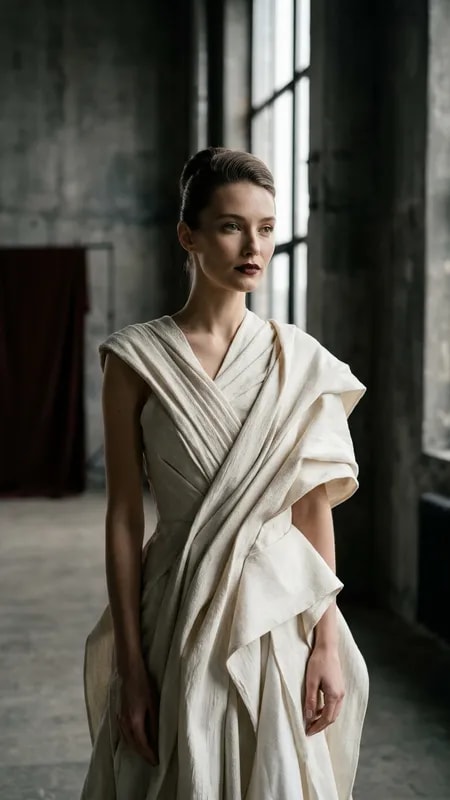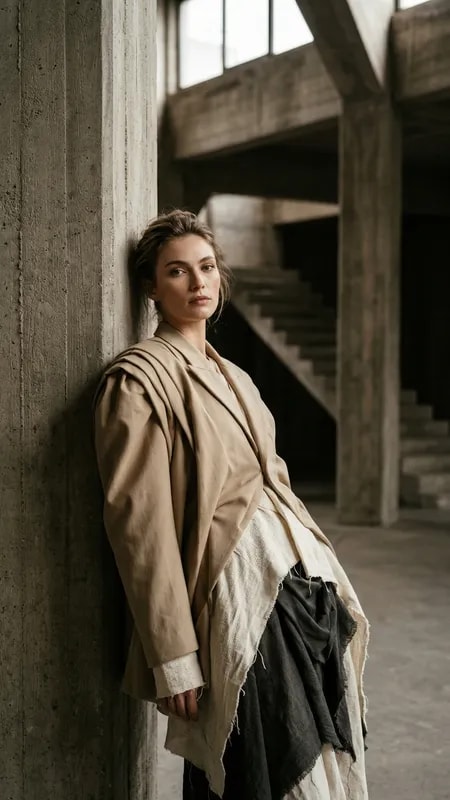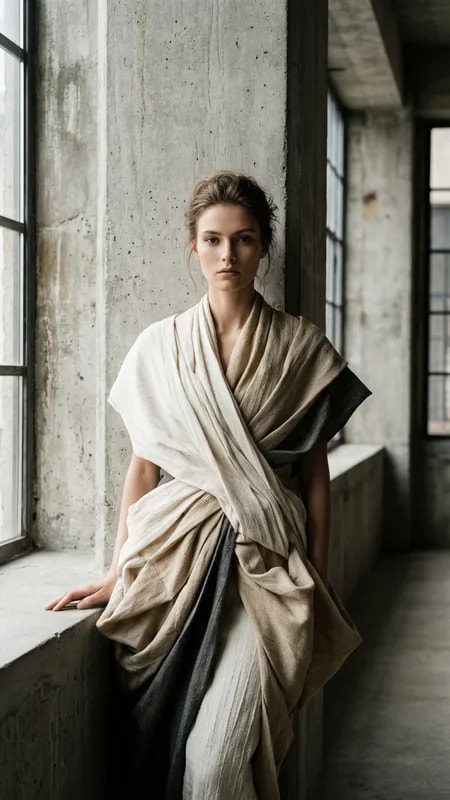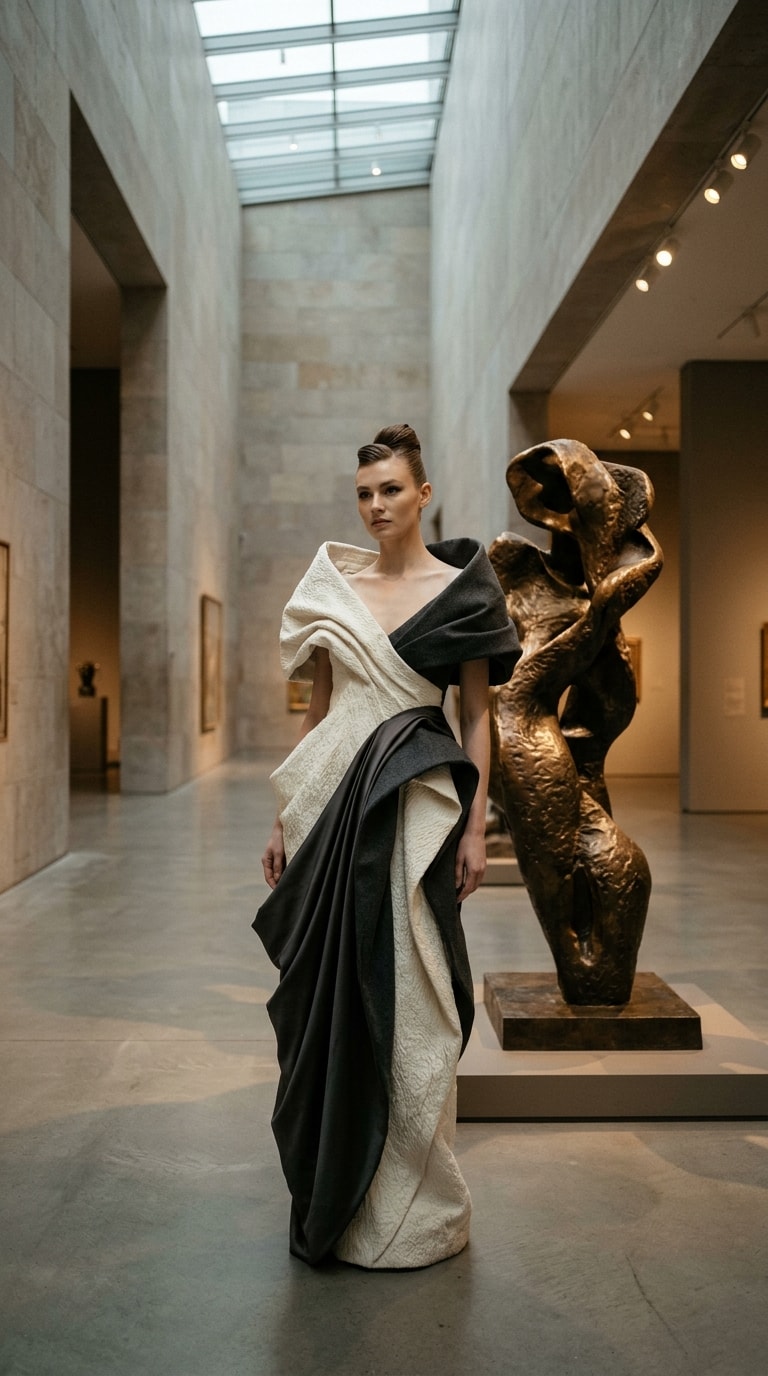
Most fashion images fight for attention. This one asks for it politely. A single figure stands in a stone gallery tall enough to make her look both monumental and small, and the room's emptiness does the loudest work in the frame. There is no crowd to part, no furniture to rearrange, no texture on the floor competing with the fabric. What remains is proportion: the long vertical of the model, the longer vertical of the wall behind her, and the cool wash of skylight falling between them.
The gown is built like a building. Sweeping black fabric gives the silhouette its weight and direction, while the textured cream sections read as surface detail, the way carved stone reads against a plain facade. Standing still, the model becomes a column; the train pools and spreads at the base like a plinth. That architectural reading is not accidental styling. When you dress a figure for a room with high ceilings and hard stone, you want fabric that holds a shape at a distance, that can be understood from across the gallery rather than only in close-up.
To her right, a twisted bronze abstraction rests on its pedestal, and the echo is unmistakable: the same spiral energy, the same dark mass against pale walls. The lighting separates them without splitting the picture. Cool diffused daylight pours from the skylight overhead, while warm spotlights pull the bronze and the canvases behind it into a lower, richer register. That temperature contrast is what keeps a neutral palette from going flat. Grays, blacks, creams, and one metallic note — it is a restrained recipe, and it works precisely because nothing else is invited in.
Technically, the frame is a study in restraint as well. A medium telephoto lens compresses the distance between model and architecture, so the gallery feels close and enormous at once, and a deep depth of field keeps the background legible instead of dissolving it into bokeh. That decision matters. Blurring the room would have turned the setting into wallpaper; keeping it sharp lets the space participate. The leading lines of the walls and the skylight's edge all point inward, funneling the eye down the figure and then out toward the sculpture.
For anyone producing a similar shoot, the lessons are practical. Scout for ceiling height before you scout for props. Shoot early, when a museum is closed to visitors and the light is at its most even. Choose garments that read as silhouette first and detail second. Then let the emptiness stay empty — resist the urge to fill a beautiful room, because the space between a woman and a bronze is often the most eloquent thing in the picture.