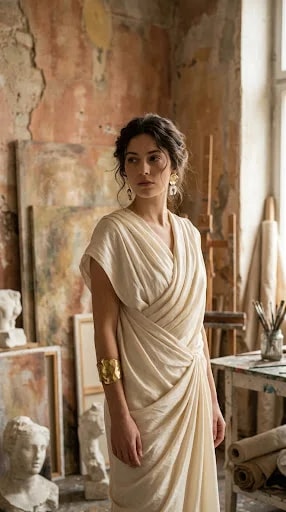
There is a particular kind of dressing that only makes sense in a room where things are half-finished. The woman in the atelier is not wearing an outfit so much as she is agreeing with her surroundings: the cream dress falling in loose, unforced folds, the gold cuff catching the window light, the terracotta wall breathing behind her. Muse fashion style has always been less about garments than about atmosphere, and here the atmosphere is doing at least half the work.
Look at what the room contributes. Peeling plaster in ochre and muted brown gives the dress its warmth; without that wall, cream would read as blank. The plaster busts and rolled paper leaning in the corners supply the classical reference that a simple draped silhouette needs to feel intentional rather than accidental. This is the quiet trick of atelier dressing: you borrow gravitas from the objects around you. A blank canvas behind your shoulder says more about restraint than any amount of tailoring.
The clothing itself is deliberately sparse. One dress, one pair of bold gold earrings, one sculptural bracelet — and nothing else competing for attention. The fabric matters more than the cut; it should catch light the way the gown does here, with soft folds that shift as the wearer moves and shadows that deepen in the late afternoon. Ivory, bone, oatmeal, a washed linen the color of old paper — these are the shades that hold up against stone, wood, and dust. Saturated color would fight the room. Neutral lets the room speak.
Jewelry is where the styling earns its edge. Against all that softness, a hammered cuff and oversized hoops act like small pieces of sculpture, echoing the busts on the shelf. The rule is scale, not sparkle: fewer pieces, heavier, with visible texture. A single dramatic form reads as deliberate; five delicate ones read as decoration.
What makes the look timeless is that it never announces itself. It is introspective rather than performative, romantic without costume. Anyone can recreate the effect at home by choosing one well-draped neutral dress, one piece of sculptural metal, and a corner of a room with honest texture — bare wood, unfinished plaster, a stack of books, good light from one side. The muse is not the woman in the atelier. The muse is the composure she keeps while the work around her stays unfinished.