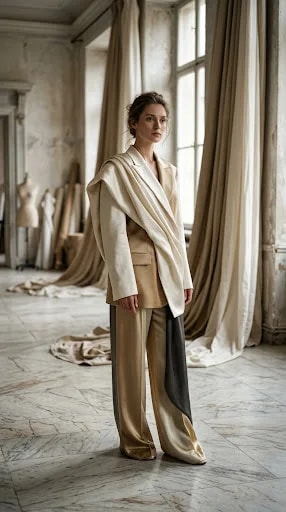
The room arrives before the clothes do. Tall windows, curtains falling in long unbroken columns, a marble floor that has been walked on for a century and shows it. She stands in the middle of it — not posed so much as paused — and the atelier gathers around her: dress forms in half-finished silhouettes, bolts of fabric leaning into a corner, textiles pooled on the ground like something spilled and left.
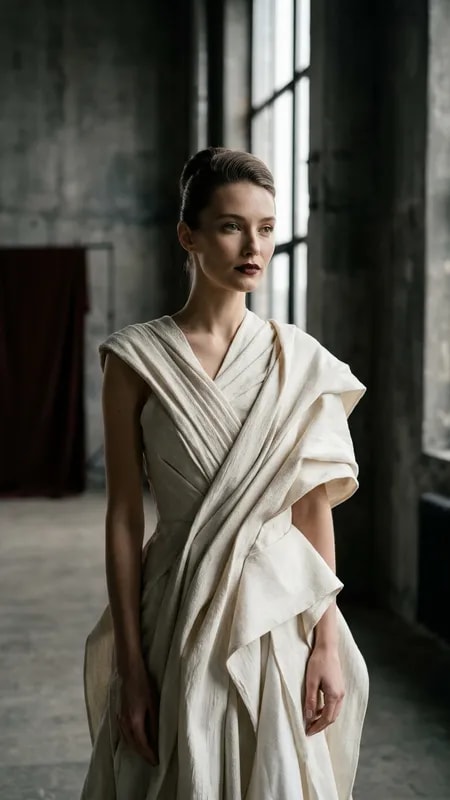
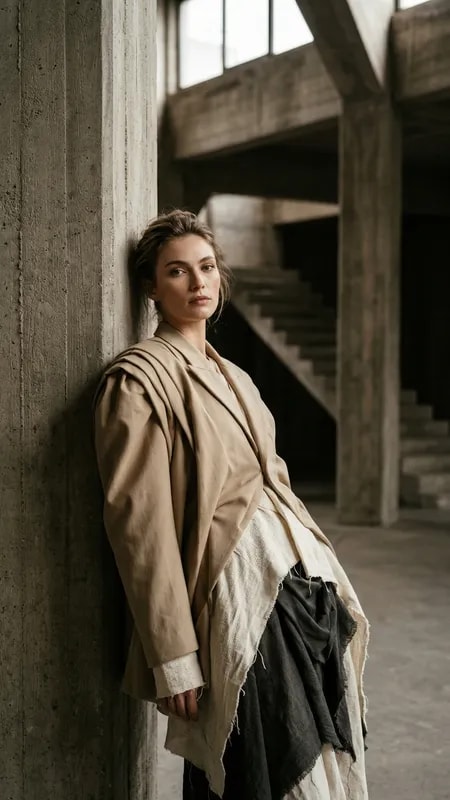
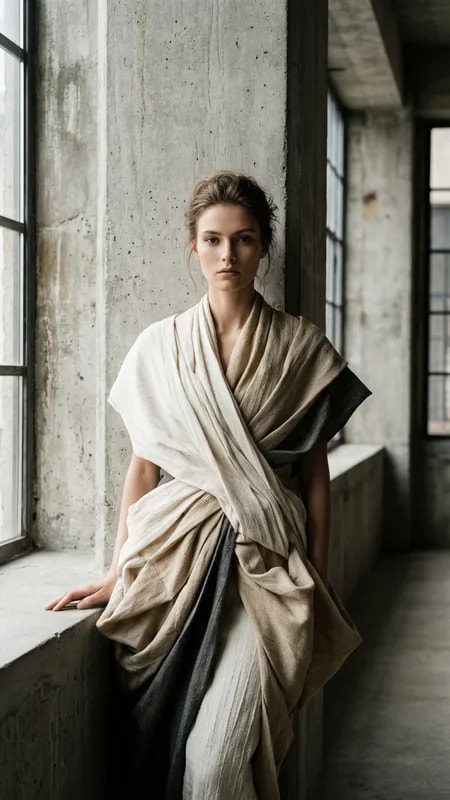
What makes the frame work is restraint. Cream, sand, taupe, charcoal, the cool grey of veined stone — a palette narrow enough to feel deliberate and wide enough to keep the eye moving. Nothing competes. The diffused daylight through the windows does the rest, softening edges and letting shadow sit lightly in the folds of the curtain behind her. It is the kind of light that flatters fabric more than skin, which is exactly the point in an editorial built on drape.
Her outfit reads as tailoring that has been talked out of its stiffness. An ivory shawl is thrown over a soft beige blazer, its folds falling asymmetrically, and beneath it the wide-leg trousers mix champagne satin with dark charcoal panels. The satin catches a low sheen where the light grazes it; the charcoal absorbs everything. Together they give the silhouette movement while she stands completely still — a quiet argument between polish and ease that the whole picture seems to be having.
The atelier deserves credit as a collaborator. Dress forms, rolled fabric, the faint disorder of a working room: these details turn a portrait into a scene. You read preparation rather than presentation, the last minutes before a fitting, a model waiting while someone searches for the right pin. There is something faintly melancholic about it, a room that has outlived its own glamour, and that melancholy is what keeps the image from tipping into ordinary luxury advertising.
Worth borrowing for your own pictures: choose a room with history over a seamless backdrop, hold the palette to four tones, and let one fabric shine while another goes matte. Then stand still and let the space do the talking. In this frame the stillness is the styling, and the muse is as much the room as the woman in it.