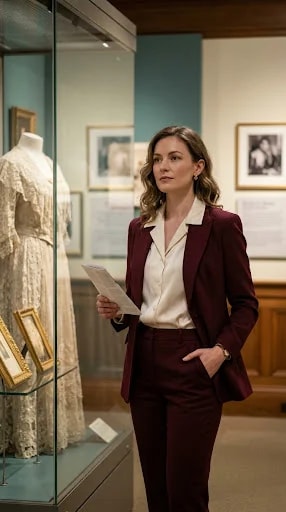
On the right third of the gallery, a woman in a deep burgundy suit and cream blouse stands before a glass case, a document held loosely in one hand. Her gaze goes to the dress inside: cream lace, elaborate, lit softly against a mannequin. Around her, teal wall panels, framed black-and-white portraits, and warm wood trim hold the room in a hush. The scene is not a fashion shoot. It is the everyday ritual of a visitor giving a historical garment her full attention.
That attention runs both ways. The lace dress is the obvious artifact, but the visitor's suit is also a piece of women's history in the making—a present-day uniform of authority, chosen in a color that feels deliberate without shouting. In women's history museum fashion, the conversation rarely stays inside the case. A pantsuit or a sharply tailored blazer can echo the garments on display without mimicking them, showing how women's workwear continues to borrow, reject, and revise the past. The oxblood suit against the ivory lace makes that exchange visible: one garment speaks of the office, the boardroom, the committee meeting; the other of ceremony, craft, and a life recorded in fabric.
Good exhibition design leaves room for that exchange. Here the composition is balanced, the case on the left, the visitor on the right, with soft depth separating foreground from background. The palette—burgundy, cream, muted teal, wood—keeps the photograph calm rather than theatrical. A short telephoto lens compresses the space just enough to make the dress and the woman feel connected, while the gentle blur keeps the wall text from competing. The label near the base of the mannequin is small but important; it turns a beautiful object into evidence.
The document in her hand matters, too. Maybe it is a gallery guide, maybe notes for a project, maybe a label she is comparing with the display. Either way, she is not passively admiring. She is working through the exhibit, holding paper in a room designed to make the past legible. What to wear to a women's history museum is not really a dress code question. It is a question of participation. The burgundy suit does not compete with the lace dress; it answers it, carrying the story forward into the present, one careful look at a time.