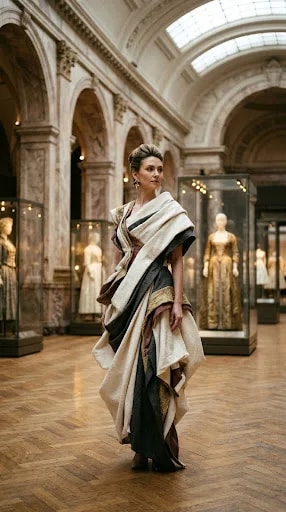
She stands dead center on the herringbone parquet, and the room arranges itself around her. Cream and black, a slash of burgundy, gold catching where the sculptural folds break — the gown is doing what the mannequins behind glass cannot. Marble arches recede into a vaulted skylight, the vitrines line up like a quiet audience, and the honeyed floor takes a soft reflection of her hem. Everything in the frame is held still by conservation except her.
That is the tension worth noticing. A museum preserves by stopping time: light lowered, temperatures pinned, each historic dress mounted on a form that will never shift its weight or turn its shoulder. The method works, but it flattens one half of the story. A garment's cut can be read on a mannequin; its behavior cannot. How a bodice answers a spine, how a train drags and recovers, how a sleeve collapses when the arm drops — those details live only in motion, and they are the ones a visitor instinctively supplies.
Look at where the light lands. Diffused daylight falls from the skylight, cool and even, while the cases throw a warmer glow upward. The gown catches both: stone-gray in the shoulders, ember along the folds. That mixed light is doing editorial work, keeping the woman crisp at a moderate depth of field while the museum softens into arches and glass. The composition argues a point without saying it. Alive in front, archived behind. She is not interrupting the collection; she is completing it.
So the fashion museum's real subject is not the objects but the continuity between them and us. The visitor is the final vitrine, and the only one without walls — which is why the best rooms reward slowness. Wear something with structure when you go: a defined shoulder, a heavy fabric, anything that holds a shape in a photograph and moves when you do. Walk the galleries at a fraction of your normal pace. Then stop in the middle of the parquet, let the cases settle around you, and give the room a few seconds to look back.