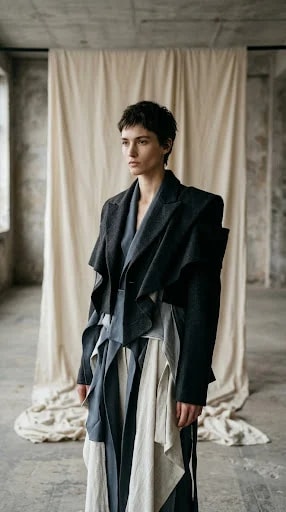
A sheet of off-white cloth drops from ceiling to floor and gathers where it lands, and suddenly the room has two architectures: the poured concrete that holds everything up, and the fabric that decides where the eye rests. The model stands between them, closer to the cloth than to any wall, and the composition reads less like a portrait than a floor plan. Window light enters from the left, soft and unspectacular, and the shadows it leaves behind are what give both surfaces their grain.
The garment answers the room's geometry without imitating it. Exaggerated shoulders push outward in black, structured enough to look carved, while the layered lapels deconstruct into strips of cream, grey, and charcoal that fall and pool into a skirt. Nothing about it is finished in the conventional sense — the fabric is still deciding what shape it wants to be, trailing downward long after the jacket has made its point. Against raw concrete, that unfinished quality is the whole argument: cloth can be soft and structural at once, and so can the person wearing it.
The muse here is not decorative. Cropped dark hair, pale skin, no visible gesture, a gaze that stays inside the frame rather than reaching for the viewer. The androgyny matters less as a statement than as a form of restraint — a face and body reduced to line and posture, letting the silhouette carry the drama. Everything theatrical in the image has been moved onto the shoulders and the pooled hem, which leaves the person free to stand there with the calm of someone who already knows the picture works.
For anyone building a shoot like this, the mechanics are simple and unforgiving. One prop, used at full scale, beats five used decoratively. A palette of black, charcoal, bone, and concrete grey will hold together in almost any light, and diffused daylight from a single window will do more than a bank of strobes when the surfaces are this textured. Keep the camera at a medium distance, sharp on the face, softer at the edges, and let the floor stay visible so the eye can measure how far the fabric has traveled.
What the image finally proposes is that a muse can be a room as much as a person. The cloth shelters, the concrete resists, and the figure in the middle translates between them — dressed in fragments, standing still, holding the whole vertical frame together by refusing to fill it.