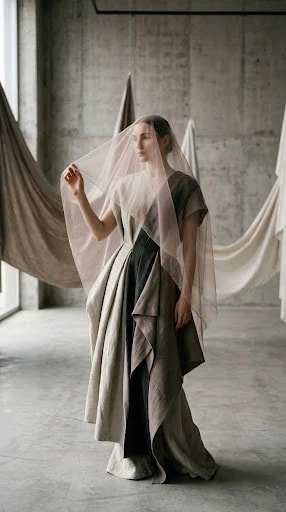
There is a moment in every muse core fashion story where the fabric stops behaving like clothing and starts behaving like atmosphere. Here it happens at the head: a translucent veil, gathered loosely and held at one side, softening the model's silhouette without hiding it. Beneath sits a dress of layered taupe, charcoal, and off-white panels, cut asymmetrically so the eye travels diagonally down the body. Nothing shouts. Everything is considered.
The setting does half the work. A raw concrete room, tall windows on the left, and long lengths of pale cloth hanging and pooling at the edges — the room reads as a studio mid-thought, unfinished on purpose. Diffused daylight slides in from the window and lands matte, no gloss, no sparkle. Against that cool gray, the warm sand tones of the dress glow quietly, and the muted black panels give the whole look a spine. This is the muse core fashion equation in its purest form: tactile fabric, brutal architecture, and a palette that refuses to raise its voice.
What makes the veil more than a styling trick is the tension it creates. Sheer fabric is fragile by nature; the structured drape beneath it is not. Held together, they argue gently — softness over architecture, secrecy over exposure. The veil also does something flattering and slightly mysterious to the face, diffusing features the way the window diffuses light. Photographers love this because it gives the eye somewhere to rest before traveling down to the hem, where the layers stack and pool into the floor.
To borrow the idea for real life, start with one sheer layer and one structured piece, never two of each. A gauze scarf over a heavy asymmetric dress. A translucent overlay on a wool column. Keep the palette to three tones pulled from the same dusty family — sand, stone, chalk — and let the concrete-gray of your surroundings act as the neutral. Skip jewelry that catches light; the point is a surface that absorbs it.
What lingers is the stillness. The model isn't posing so much as standing inside the frame, letting the fabric and the light do the arguing. That composure is the real export of muse core fashion — not a specific dress, but a way of occupying a room with very little noise and a great deal of presence.