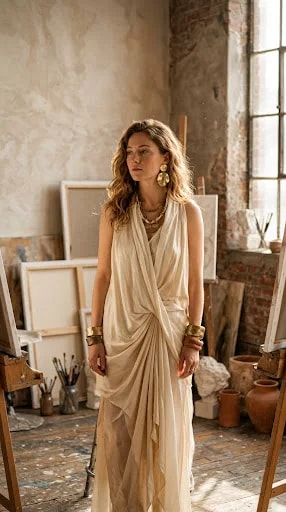
The dress does most of its work in a single gesture: cream fabric gathered at the neck, twisted once at the waist, then left to fall. Nothing about it is complicated, which is exactly why it holds up against a room full of clutter. In a studio crowded with easels, jars of brushes and half-finished canvases, a dress that announces itself too loudly would lose. This one borrows the room's quiet instead, and the soft light coming in from the right does the rest, catching the folds at the hip and dropping gentle shadow into the pleats.
Look closely and you notice the palette isn't invented so much as lifted. The cream of the dress sits a shade lighter than the blank canvas behind her, a shade warmer than the plaster bust, and a full step away from the terracotta pots on the shelf. That is the trick worth stealing: match the undertone of the room, not the exact color. A pure white would have gone cold and clinical against brick and clay. An off-white with a little yellow in it reads as though it belongs to the building. When you are dressing or shooting in a textured space, hold a fabric sample against three surfaces before you commit — the wall, the floor, and the nearest object that isn't furniture.
Gold does the counterweight. Against matte, unstarched fabric, delicate metal can vanish, so the jewelry here is deliberately heavy: a wide cuff, layered chains of slightly different weights, earrings big enough to be read from across the room. Warm gold flatters cream in a way silver rarely manages, pulling out the fabric's yellow rather than fighting it. On a lighter budget, one substantial piece beats five thin ones every time, because the eye registers mass before it registers detail.
Then there is the grooming, which is really just restraint. Bare arms, hair pushed back off the face, skin left mostly alone. The light in this frame is directional and soft, the kind that finds a jawline and forgives everything else, and makeup that tries to compete with it turns muddy. Let the window do the contouring.
The crop matters too. Ending the frame at the calf keeps attention on the drape and the jewelry, and it leaves the floor to the room: the dust, the dropped brush, the evidence that someone was actually working here. Muse style isn't about standing in a studio looking decorative. It is about choosing clothes that let the place finish the sentence.