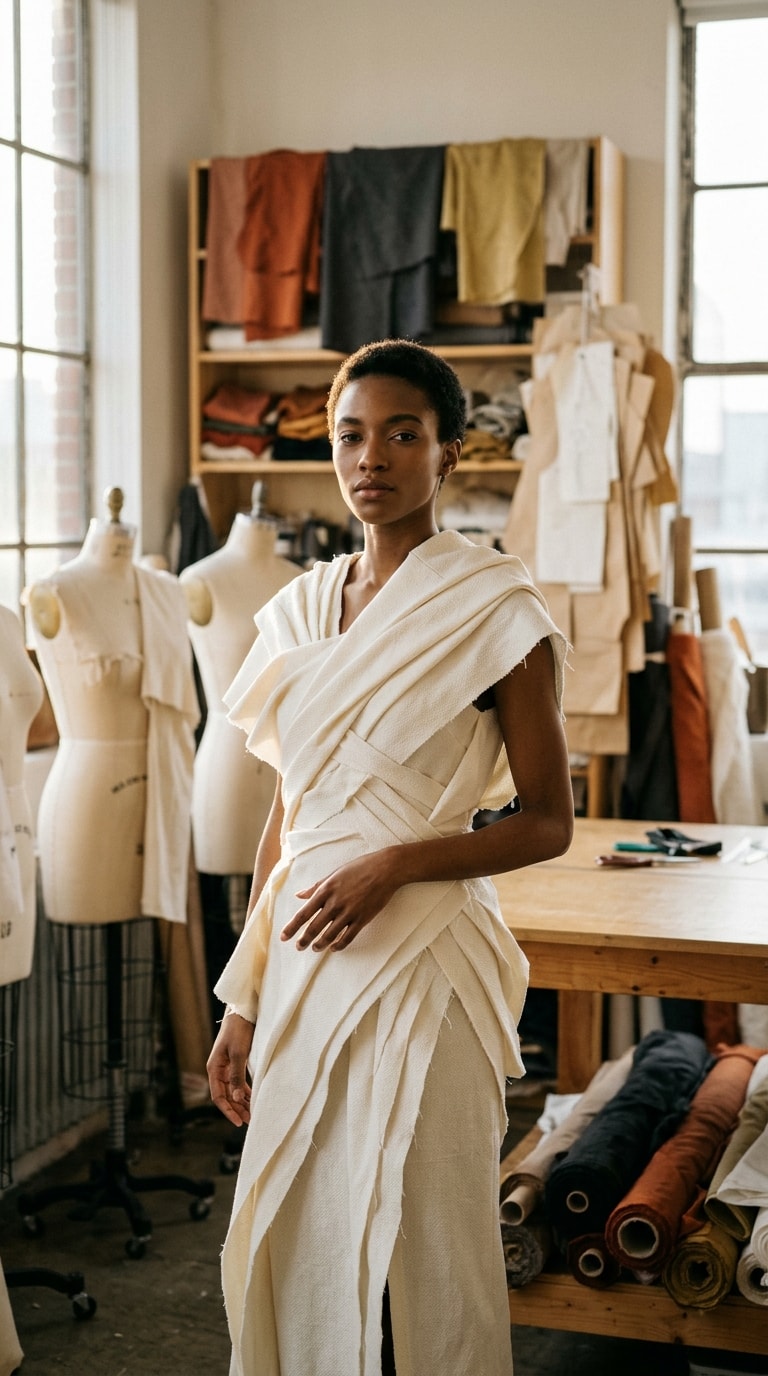
There is a particular hour in a working atelier when nothing is being sewn and everything is being decided. The dress forms stand half-dressed in pinned muslin, a wooden table holds chalk and shears, and rolls of cloth lean against the shelves in terracotta, oatmeal, and bone. In the middle of it all stands the person the collection is actually being built around, wearing an off-white garment whose folds have not yet agreed with each other. This is the moment before the sample becomes a sample: the fitting where a designer stops sketching and starts listening.
Standing still is labor. A muse who can hold a shoulder at the exact angle that makes a pleat fall cleanly is doing something a dress form cannot, because a dress form has no weight shift, no breath, no habit of tilting the head. The draped ivory fabric in this frame looks sculptural precisely because a real body is underneath it, resisting and redirecting the cloth. Watch where the light gathers along the diagonal folds and you can read the conversation: the designer pushed the fabric one way, the wearer's posture answered back, and what survived the exchange is the silhouette.
The setting matters as much as the garment. Soft window light, unbothered by reflectors, drifts across the room and settles on the textile rolls in the foreground, pulling out the nubby texture of wool and the faint sheen of a silk remnant. The shallow focus keeps the eye on her face and hands while the atelier dissolves into warm blur behind her, and that blur is not incidental. It tells you the room is lived-in, that the shelves were stocked over years rather than styled in an afternoon, and that the calm in her expression comes from familiarity rather than performance.
What makes an image like this useful is its honesty about process. Nothing here is finished. The hem is unresolved, the pins are still in the form behind her, and the palette of cream, wood, and clay reads like a mood board that has been breathed on rather than framed. That is the difference between a muse photograph and a campaign photograph: one shows the argument, the other shows the verdict.
If you are documenting a studio, resist the urge to tidy it. Leave the fabric rolls where they fell, let the window do the lighting, and give the person wearing the work enough quiet to look like themselves. The garment will look better for it, and so will the story of how it came to exist.