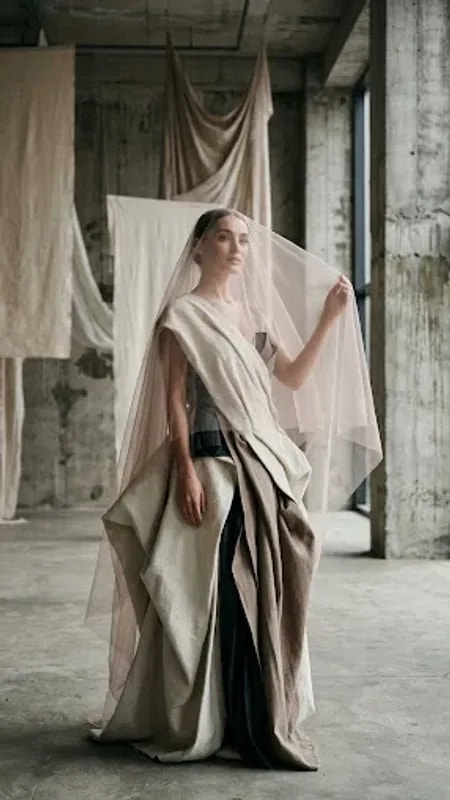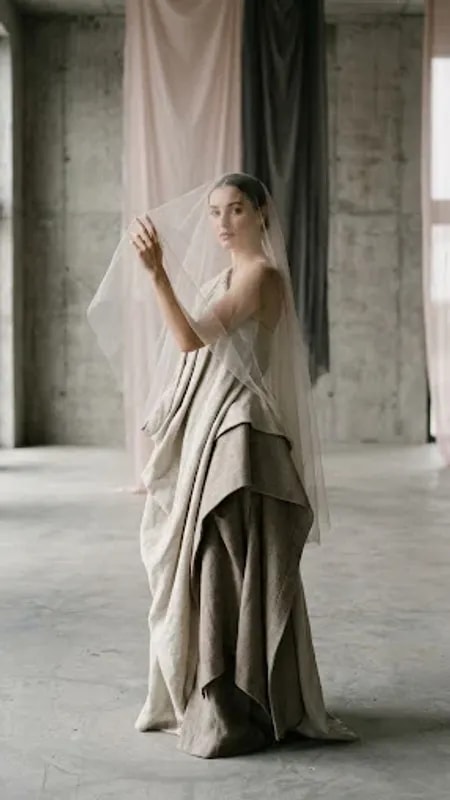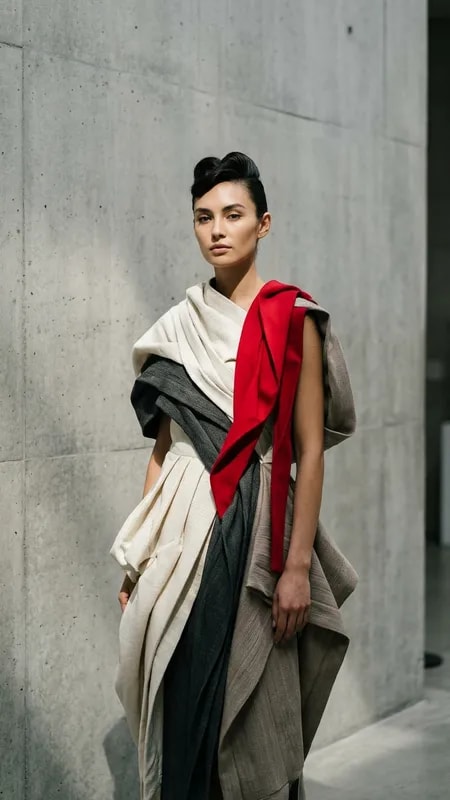
There is a moment in every collection, long before the runway, when a garment exists only as a question. A length of cream fabric is pinned, unpinned, and pinned again. Paper patterns curl at the edges of the wall. And somewhere in the middle of all that unfinished thinking stands the person for whom the clothes are being imagined — the muse, present not as decoration but as a participant in the work.
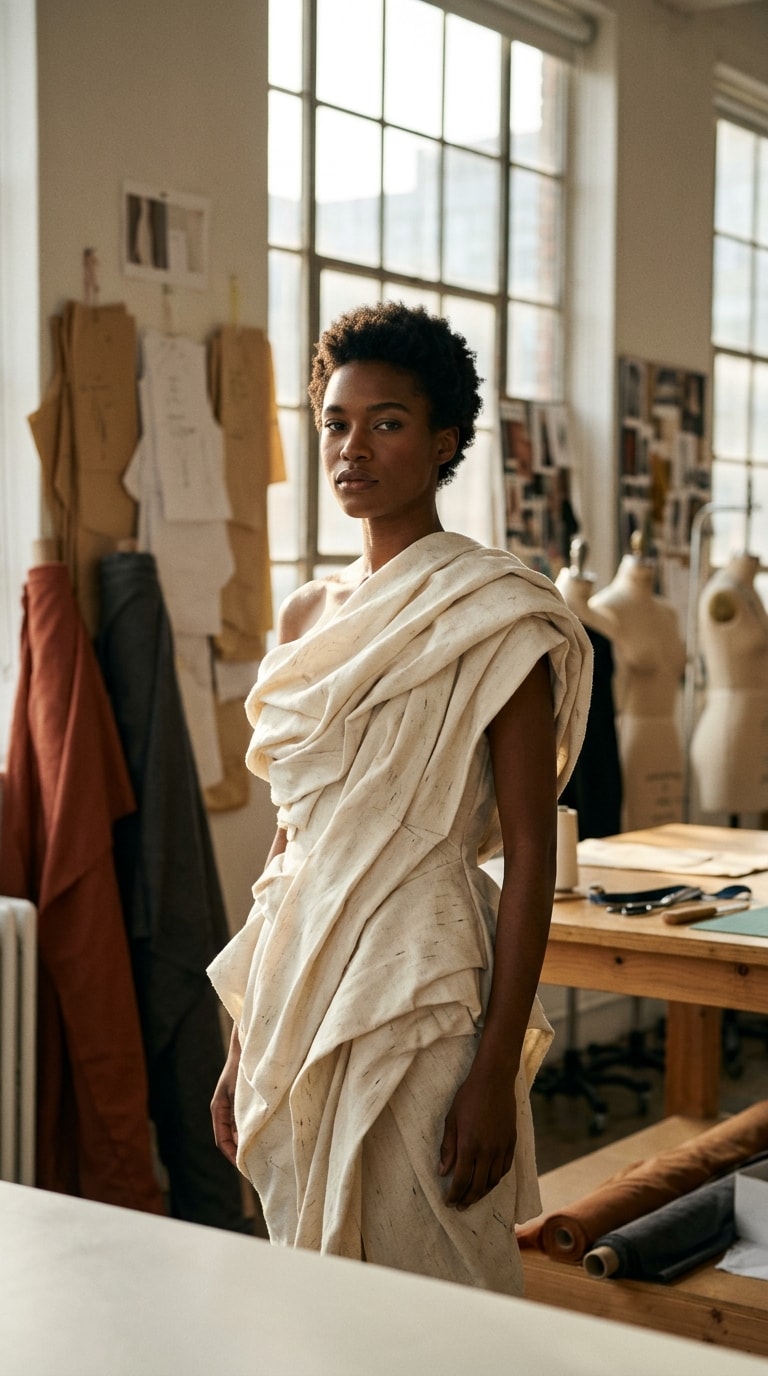
In the studio, the muse is surrounded by the evidence of craft. Rolls of cloth lean against a wooden table, swatches of rust and charcoal hang within arm's reach, dress forms wait in the half-light. She wears a sculptural, asymmetrical piece of layered cream, cut so the seams read as architecture rather than ornament. Nothing about the scene is staged for spectacle. The sketches pinned nearby are working drawings, the sewing tools are within reach, and the light falling through tall industrial windows is the same light the tailor has been squinting into all morning. Muted tones — ivory, sand, taupe, a thread of rust — keep the focus on texture and silhouette instead of noise.
What makes a muse useful to a designer is not a particular look but a particular quality of attention. She has to be able to stand still and be honest. When she turns, the fabric tells the designer something: where the drape collapses, where a shoulder needs less, where the weight of the cloth fights the line of the body. Her calm, direct gaze in this portrait is the whole point — she isn't performing for the camera so much as letting herself be read. That self-possession is what turns a sketch into something a real person can wear.
There is a quietness to the atelier that rarely makes it into the finished campaign. Before the fittings, before the edits, before anyone decides what the season means, there is just a room, a table, and a person standing in daylight while someone adjusts a hem. It looks like nothing is happening. In fact, everything is. The collection is being argued into existence, one pin at a time, and the muse is the argument's most reliable witness — the living proof that the idea holds up on a body, in a room, in ordinary light.
That is why editors keep returning to this image, and why designers keep returning to this kind of room. The muse is not a mannequin with a better face. She is the first audience, the hardest critic, and the reason a bolt of cream fabric stops being material and starts being a dress.