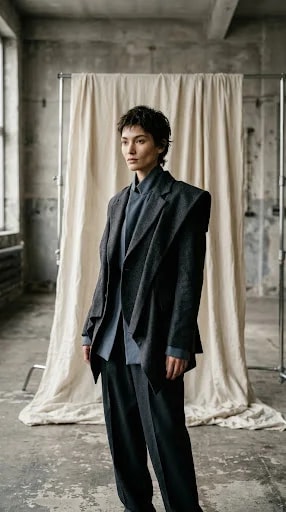
The room refuses to flatter. Concrete walls, a stained floor, the hard lines of a metal frame—nothing here is designed to make the figure feel at ease. Yet the model stands squarely at the center, framed from the knees up, wearing an oversized charcoal suit with the ease of someone who has chosen the setting rather than merely arrived in it. Behind them, a cream drape falls in loose folds, the only soft element in a hard-edged composition. That contrast is the image's argument: softness and severity can belong to the same person, and the fashion muse is often most powerful when standing between them.
The tailoring does the quiet work. The jacket's shoulders extend past the natural line, the trousers break with a deliberate weight, and the layered charcoal wool catches the side light from the large window. A standard lens keeps the proportions honest; nothing is stretched or smoothed away. You can read the nap of the fabric, the rough texture of the wall, the faint marks on the floor. The palette stays cool and muted—slate, charcoal, concrete—until the warm beige drape pulls the eye back to the body. The model's short, textured hair and unreadable expression complete the effect: hyper-real, but never overexplained.
This is where the androgynous muse becomes more than a styling decision. The suit is not borrowed from menswear or softened from womenswear; it simply creates a silhouette, and the person inside it gives that silhouette a pulse. There is no coy tilt of the head, no invitation in the gaze. The stance is firm, the hands mostly out of frame, the face held in a stoic calm that feels closer to portraiture than to promotion. In fashion, the muse is usually asked to be a mirror for a collection. Here, the figure reads as a collaborator—someone whose presence changes the room rather than the other way around.
The industrial setting matters because it strips away the usual gloss. No seamless studio, no controlled perfection—just concrete, daylight, and a drape doing its best to civilize the background. The vertical composition gives the figure gravity, while the empty space around them lets the stillness register. What lingers is not a trend or a logo but a mood: introspective elegance, quiet authority, a body at rest in a room that asks for toughness. That is the muse in fashion at full strength—not decoration, not a blank canvas, but a person who can hold a frame simply by refusing to fill it with noise.