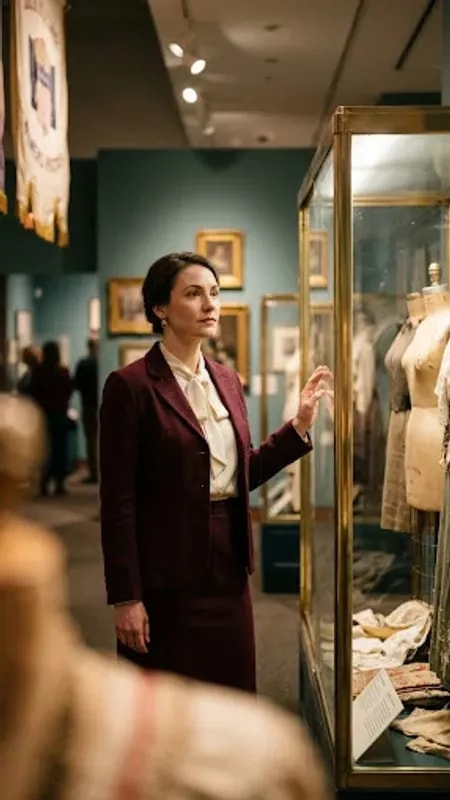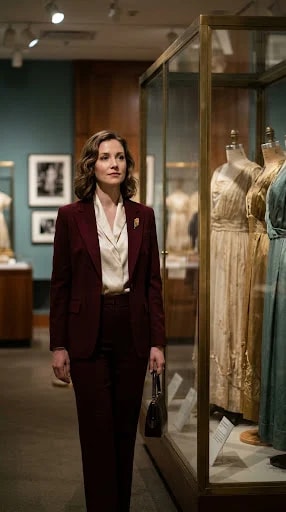
The gallery is kept deliberately low, the light pooled in narrow columns over the cases rather than spread across the ceiling. A woman in a deep burgundy pantsuit moves through it slowly, hands loose at her sides, her cream blouse tied at the throat. To her right, two mannequins stand in illuminated glass: a pale floral gown with a nipped waist, and beyond it a teal dress cut on a bias that catches the spotlight and holds it. On the teal wall behind her, framed black-and-white photographs record women whose names are printed in small type beneath the frames. The whole room is arranged so that you look at the clothes first and the people second, which is either a failure of the design or its most honest gesture.
Her suit is not neutral. The pantsuit arrived in women's wardrobes by way of borrowed tailoring, and it was contested for decades — banned in some offices, remarked upon in others, worn anyway. Seeing it here, against garments that have already been catalogued and dated, makes an unintentional point: the pantsuit is an artifact too, just one whose glass case hasn't been built yet. Museums of women's history tend to collect the dramatic objects, the suffrage sashes and the wedding lace, and they are slower to acquire the ordinary uniform of a working life. The visitor is wearing exactly that, and she is wearing it well.
What the cases hold is more careful than nostalgic. The floral gown has been mounted to show its seams, not just its silhouette, and the teal dress is lit so the fabric's weight reads from a distance. The photographs on the wall do similar work, offering faces at eye level rather than above it. This is the discipline of a good fashion exhibit: a dress is treated as evidence. It can tell you what a woman could afford, what she was permitted to do in a room, how many hands it took to fasten her before she left the house. A cream pussy-bow blouse, tied soft and slightly asymmetrical, is a detail borrowed from an earlier decade and quietly returned here.
The mood is reverent without being solemn. The shallow focus blurs the far end of the gallery, so the past recedes as you approach it, always a few steps ahead of your attention. Visitors tend to slow down in rooms like this and speak in half-voices, not because a rule requires it but because the objects seem to be listening. There is a specific pleasure in standing before a garment older than your grandmother and recognizing a decision you have made yourself — a shoulder line, a hem, a refusal.
If you go, dress with some intention. Not for photographs, and not to compete with the mannequins, but because a museum of women's history is one of the few rooms where what you chose to put on this morning is part of the conversation. Walk slowly. Read the small type. Then notice what you're wearing and ask what it will tell someone in fifty years.