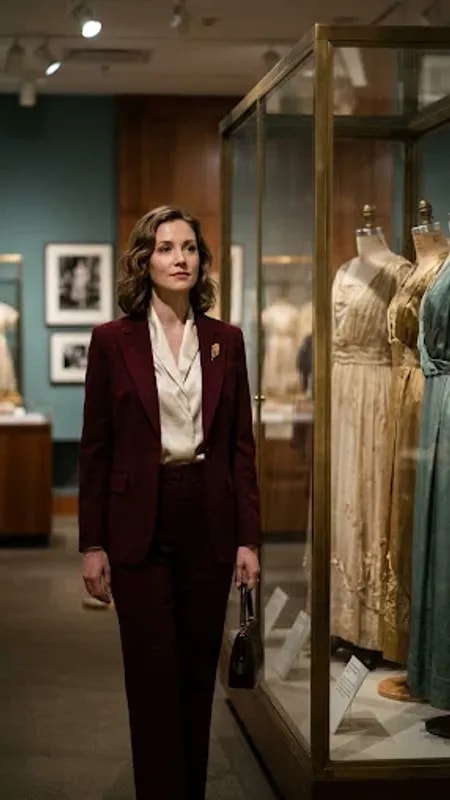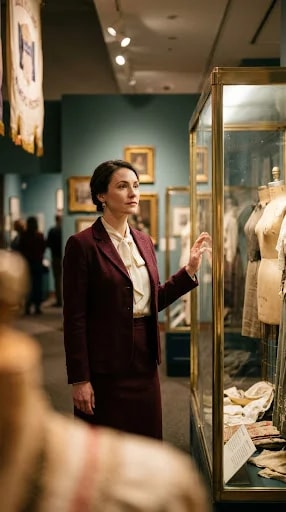
There is a specific gesture that happens in every costume gallery, and this photograph catches it mid-arc: a hand raised, fingers relaxed, stopping an inch or two short of the glass. The woman in the burgundy suit is not reaching to touch the case. She is reaching to be nearer to what is inside it, and the small distance she leaves is the whole negotiation of the museum visit. Look at her face and you see a person doing arithmetic, comparing the cream garment on the mannequin with something she remembers, or something she was told, or something she has never seen before.
Her own clothes are part of the argument. The pussy-bow blouse, cream and softly tied, rhymes with the garments behind the brass frame in a way that reads as deliberate rather than accidental. Tailoring cut close to the body, a burgundy deep enough to hold its ground against those teal walls, a collar that frames the face under the spotlight—this is someone who dressed to stand in a room of historical clothing and be seen as a continuation of it rather than a visitor from elsewhere. Fashion history is rarely about a single garment. It is about the line you can draw from a woman's blouse in 1974 to a blouse in a case in 2024, and the women standing in between.
The display itself is doing quiet work. Mounted on a torso instead of laid flat, the cream pieces keep the shape of a body—shoulders, waist, the fall of fabric where a hip once was. Glass protects them from oils on fingertips and light that never stops degrading dye, but glass also does something less practical: it turns admiration into a formal act. The brass frame marks a boundary, and the spotlight on the mannequin makes it glow like something votive. The blurred visitors behind her, the gold-framed portraits on the wall, the shallow focus that softens everything but her and the case—all of it clears a small private space in a public room.
And notice what has been elevated here. Not a portrait of a founder or a general, but a set of everyday clothes, given the same framed, lit dignity as the oil paintings nearby. That swap is the entire premise of a women's history museum, and it is why the gesture in the foreground matters. She is not bowing to a monument. She is greeting a wardrobe, and in doing so she recognizes the labor, taste, and ingenuity of women whose names the labels may not record. The glass stays up. The hand stays out. But the inch between them is where history actually gets passed along—not by touch, but by the wish to touch, which is the same thing as remembering.