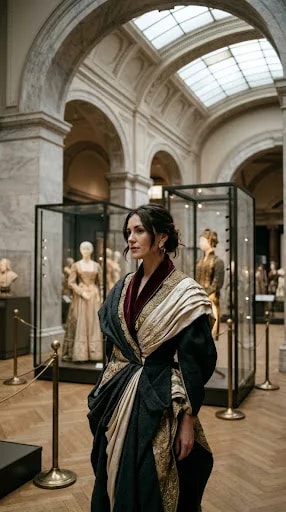
Stone arches rise on either side of the hall, meeting overhead in a lattice of skylights that pour soft, even daylight onto the herringbone floor. Brass stanchions mark a quiet path, marble busts keep their endless composure, and glass cases line the walls like chapters in a very long book. At the center of it all stands a woman in a dark, generously cut historical gown, a patterned wrap drawn across her shoulders. She is not posing so much as pausing, and the pause is the point.
Behind the glass, mannequins hold their own silent conversation in cream silks and faded wool. The distinction between the two kinds of dress on view is subtle but complete: one is preserved, pinned, and lit for study; the other is worn, and therefore alive with the small movements of breathing and turning. A shallow depth of field softens the vitrines into a warm blur, letting the figure stay sharp while history recedes politely into the background. It is a reminder that costume only fully makes sense on a body, in motion, under real light.
The building itself is doing curatorial work here. Skylights instead of spotlights mean the textures read honestly, the nap of velvet and the grain of linen catching the same diffuse glow that once fell through drawing-room windows. The palette stays muted on purpose, deep navy against creamy stone, warm brown wood, a glint of gold at the frame's edge. Nothing shouts. Even the marble busts feel like a subdued crowd, watching the living visitor pass through their corridors.
If you go, give yourself permission to slow down past the first gallery. Stand still long enough for the room's tempo to catch up with you, look at the floor before you look at the labels, and notice how the architecture rehearses the clothes: the vertical arches echoing a narrow silhouette, the cool stone answering a somber navy. Fashion museums are rarely about garments alone. They are about atmosphere, about the strange dignity of a dress that outlived its wearer, and about the brief, generous illusion that you have stepped backward into a century that is kind enough to let you look around.
That illusion is fragile and easy to break with a phone screen or a hurried tour group. Protect it. Walk the length of the hall once without stopping, then return to the case that caught your eye and stay. The reward is a stillness that no photograph quite captures, the sense of standing inside a display rather than in front of one.