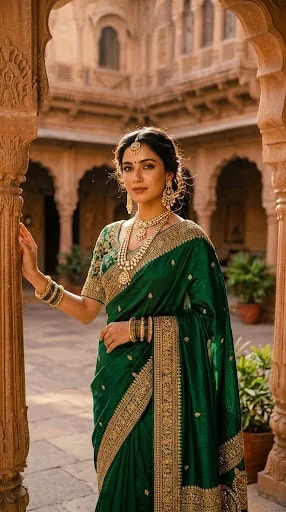
There is a quiet negotiation happening in this frame between the woman and the building. She leans into the carved stone pillar as though it were furniture in her own home, one shoulder relaxed against granite that has outlasted generations. That single gesture does more work than any styled pose could: it tells us she belongs here. The pillar crops the left edge, the sandstone archway softens behind her, and the eye travels a clean diagonal from carved capital to gold-threaded sari to her steady, unhurried gaze.
Costume and architecture share a palette, and that is the real engine of the image. Deep emerald against terracotta, gold zari against the warm grit of Rajasthani stone, the metallic glint of a maang tikka and stacked bangles answering the same light that rakes across the courtyard wall. Nothing clashes, because nothing was chosen in isolation. When you style a heritage setting, treat the building as a swatch: pull your jewel tones from the masonry's shadows, then let one saturated garment carry the frame. Here the green is the only cool note in a field of earth tones, which is precisely why it holds the center.
Lighting does the rest. The warmth reads as late afternoon, low and diffuse, the kind of light that flatters embroidery because it grazes the surface rather than flattening it. A long lens at a wide aperture keeps the potted plants and the corridor beyond in a gentle blur, so the courtyard suggests depth without competing for attention. Notice how the background stays legible as a place, arch and shadow still readable, but never sharp enough to pull focus. That balance is the difference between a portrait set in a location and a portrait swallowed by one.
What lingers is the composure. Traditional jewelry of this weight can overwhelm a face, and it doesn't here, because the styling stays disciplined: one focal ornament at the brow, layered necklaces that follow the sari's neckline rather than fight it, bangles stacked to the wrist and no further. The result feels inherited rather than borrowed, less a fashion shoot than a portrait of someone standing in a house her family might have known. For anyone shooting an Indian fashion muse in a heritage courtyard, the lesson is simple: choose the light, trust the stone, and let the woman lean.