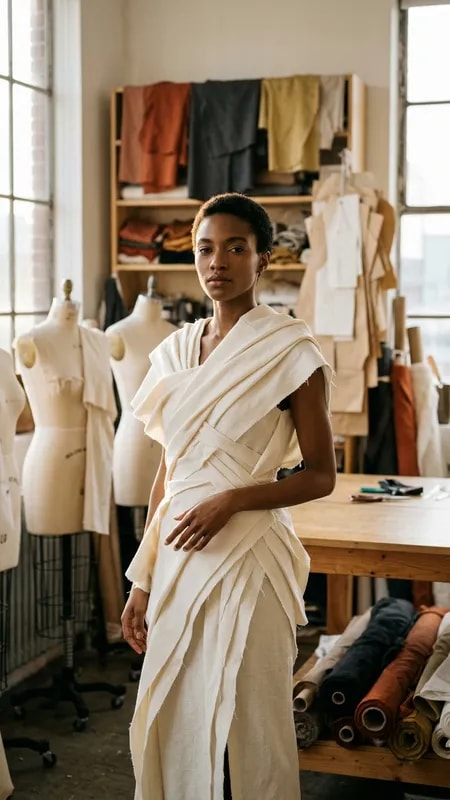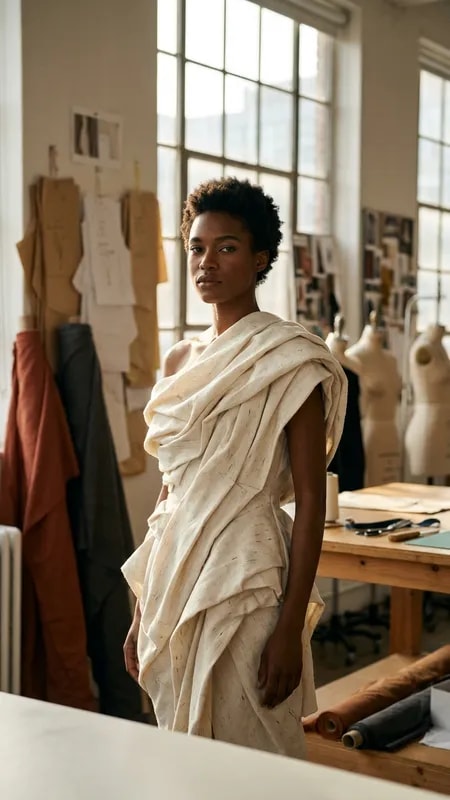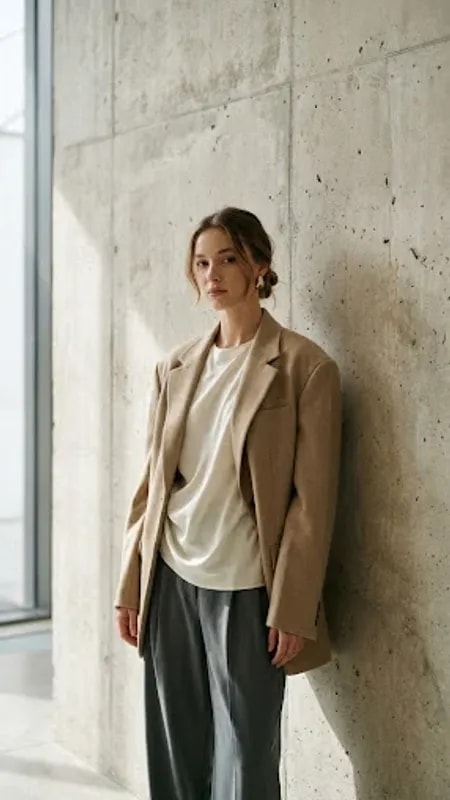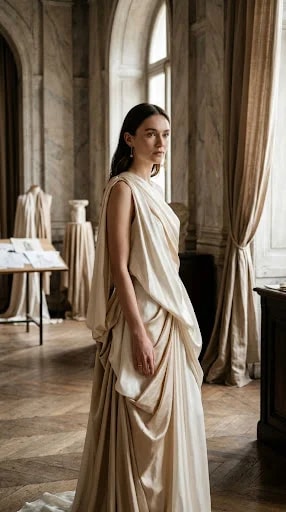
There is a particular kind of hush in a couture workroom before a fitting: bolts of fabric leaning against the wall, a dress form still pinned at the shoulder, sketches curling at the corner of a worktable. In this frame, a dark-haired woman stands at the center of exactly that scene, wrapped in a floor-length ivory satin gown whose asymmetric drapery gathers and folds like a modern Grecian column. Arched window light falls from the right, sculpting the fabric rather than flattening it. She is not posing for a crowd. She is simply standing, and the room arranges itself around her.
That is the essence of the luxury fashion muse aesthetic: presence over spectacle. The gown does the dramatic work, so the woman does not have to. Notice how little is happening—no jewelry stacked to the collarbone, no competing pattern, no hard flash. The palette stays warm and restrained: cream, champagne, stone gray, walnut, deep brown. Heavy taupe curtains and herringbone parquet give the light something soft to land on. Even the props are quiet ones, a stone bust, a draped mannequin, a dark cabinet edge. Restraint is the luxury signal here, not abundance.
Translating this into a wardrobe comes down to three decisions. First, fabric weight: satin, duchesse, heavy crepe, and wool that holds a fold instead of collapsing. Second, a single gesture of drapery—one asymmetric gather, one cowl, one sleeve that falls past the wrist—rather than several at once. Third, a palette built from three or four adjacent neutrals so the texture, not the color, becomes the thing people notice. The same logic works in a room: one sculptural piece, warm plaster or stone walls, and daylight allowed to move across the surface through the day.
What makes the image linger, though, is the expression. Her gaze is direct and unhurried, her posture settled, her hands at rest. She reads as a participant in the making of the dress rather than a decoration placed inside the room. That composure is the hardest part of the aesthetic to copy and the most worth practicing. Stand as if the room were yours, wear the fabric rather than letting it wear you, and the muse quality follows. Everything else—the parquet, the satin, the window light—is staging.