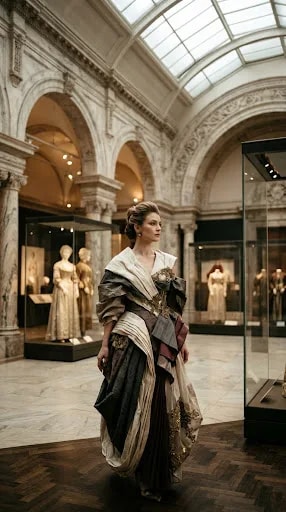
Stand in the middle of a great museum hall and the building starts dressing you. That is the first thing this scene gets right. The woman in the charcoal, cream, and burgundy gown is not simply wearing a garment; she is wearing the room, and the room is wearing her back. Arched marble columns rise past the height of any human, the glass skylight opens a pale ceiling of weather above, and the dress answers with structured shoulders and gold accents that read as architecture in fabric. Curators call this dialogue between object and environment interpretation. Visitors just feel it as awe.
Light does most of the quiet work. Daylight filters down through the skylight, soft and slightly cool, while the vitrines along the walls glow with warm spotlights aimed at mannequins in vintage dresses. Two temperatures, two moods, one hall. On a living body, that mixed light reveals what a case cannot always show: how velvet catches at the shoulder, how a heavy hem drags the eye downward, how burgundy deepens to near-black in the shadow of a column. Museum lighting is designed to protect textiles from damage, but it also flatters them, and standing inside that pool of diffused brightness is the closest most of us will get to seeing a nineteenth-century silhouette the way its first wearer did.
Behind her, the vitrines hold their mannequins in perfect stillness, and the contrast is the whole story. A dressed figure behind glass is an argument; a dressed figure in open space is a question. The mannequins preserve, measure, and explain. The woman moves, breathes, and casts a shadow across the marble. Seeing both in one frame reminds you that fashion history is not a row of frozen silhouettes but a sequence of bodies that once turned, climbed stairs, and squeezed through doorways in exactly these clothes.
Photographing historic dress full-length, at eye level, with a slightly wide lens is a deliberate choice, and a smart one. Cropping a gown at the waist destroys the proportions the cut was built to create. Volume needs room. The wide framing here keeps the entire fall of the skirt while the shallow focus softens the background into sepia and grey, so the dress stays sharp and the hall becomes atmosphere. The scale of the columns is what makes the figure read as small and grand at once.
Next time you visit, walk to the center of the largest room before you look at anything in a case. Find the axis of the hall, stand on it, and notice how the space edits the clothes on display. Then look at the one garment that seems to belong to the building rather than to the glass.