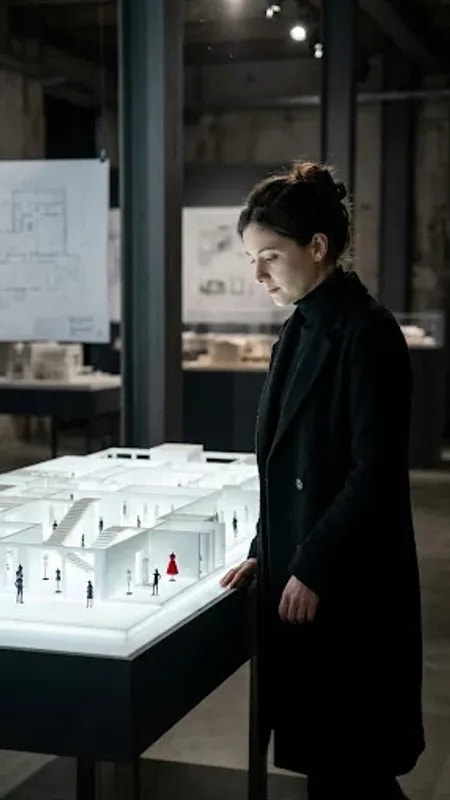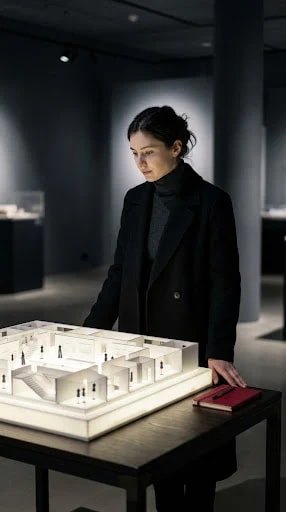
Long before a single garment leaves its tissue, the exhibition exists as a small white object on a table in an unlit room. In the photograph, a woman in a black coat leans over exactly that object: a card-and-foam model of a fashion museum floor plan, its interior walls, vitrines and staircase picked out by a single soft light. She is not browsing. She is checking whether the plan behaves the way she imagined it would at full scale, one fingertip away from moving a wall.
What a model of this kind offers that a screen cannot is physical consequence. A drawing will happily accept any corridor width; a card model refuses. You can see at a glance whether a visitor entering the costume gallery will meet a long axial view or a slow turn, whether the queue for the blockbuster room will spill into the textiles display, whether the ramp up to the mezzanine steals light from the cases below. Curators and designers stand at these tables and argue about centimeters. The tiny staircase in the model is not decoration — it is the moment where the whole circulation logic either holds or collapses.
The palette in the room tells its own story. Everything is charcoal, gray and black, the gallery around her dimmed to nothing, so that the model glows like a lit stage. That contrast is deliberate in more ways than one: the exhibition is still an idea, and ideas need darkness around them to be seen clearly. The slim red notebook at the edge of the table is the only warm note in the frame, and it is where the decisions go — the wall that has to move forty centimeters, the case that needs another ten, the label rail that will be too low for anyone over sixty.
There is a reason fashion exhibitions in particular are tested this way. Garments are fragile, three-dimensional and stubbornly human in scale; a mannequin needs breathing room, a train needs floor, a corset needs a sightline that flatters rather than flattens. Designers pace out those distances around a model before committing to a build. The quiet triangle in this image — her face, her hands, the small white building — is the real design review, the private moment when a floor plan stops being a document and becomes a place someone will walk through.