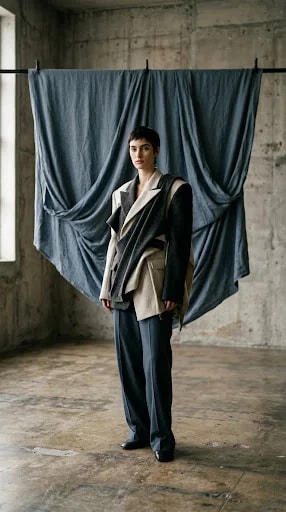
There is a particular kind of fashion image that refuses to shout, and this is one of them. The setting does most of the arguing: gritty concrete walls, a floor scuffed by years of use, a wide window on the left letting in soft, undiffused daylight. Then, hung from a black metal rod, a long expanse of blue-grey fabric falls in heavy folds like a stage curtain that forgot to close. Into that raw, half-finished space steps a single figure who does not pose so much as stand. The stillness is the statement.
The wardrobe answers the room rather than competing with it. A sculptural jacket built from layered panels of beige, cream, and black sits somewhere between tailoring and architecture, its seams deliberately exposed, its silhouette refusing the usual shoulder line. Wide slate-blue trousers anchor the volume below. Deconstruction, done well, is never about damage; it is about showing the thinking. Here you can read every decision — where a panel turns, where a hem is left raw, where a darker fabric interrupts the pale ones. The palette stays muted and earthy on purpose, because a limited range lets texture carry the emotion that color would otherwise steal.
The figure at the center is androgynous in the truest sense: not a blurring of categories for shock value, but a presence that makes the categories feel beside the point. A short dark crop, no visible styling tricks, a gaze directed past the lens. That is the muse's real work. A muse is not a passive hanger for a designer's ideas; the muse is the person who makes an unfinished idea legible. Standing dead center, framed by a slightly compressed medium-format lens, this one holds the whole composition together the way a keystone holds an arch.
What lingers is the mood — quiet melancholy, raw artistic intensity, the sense of walking into a private moment of creative concentration that was never meant to be interrupted. The contrast does it: heavy fabric against bare concrete, theatrical drapery against a working space, elaborate construction against absolute physical calm. For stylists and photographers, the lesson is practical. Find a room with honest surfaces. Hang one large textile to soften the background without decorating it. Keep the palette to three or four muted tones and let the garment's structure do the talking. Then ask your subject to do almost nothing at all, and give them enough light to be seen.