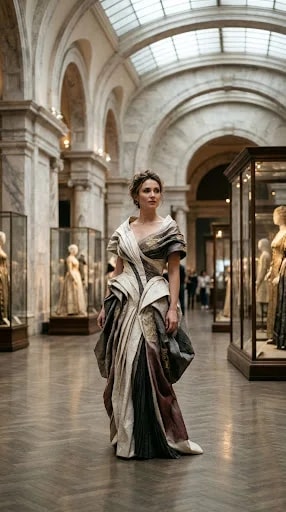
There is a particular hour in a great museum when the daylight goes soft and the whole hall seems to hold its breath. Under a glass roof, in a corridor of pale stone arches, one figure stands at the exact center of the view, and the building arranges itself around her: the vaulting overhead, the display cases lining both sides like a corridor of reliquaries, the herringbone parquet pulling the eye forward into depth. She is not the largest thing in the room. She is simply the thing the room is about.
Her gown does the arguing. It is a sculptural piece, its folds built rather than merely sewn, cascading in a controlled avalanche of pewter, cream, muted burgundy, and black. Against the stone greys and antique golds of the architecture, the palette reads as deliberate restraint: nothing shouts, everything holds. The bodice keeps its shape the way carved material keeps its shape, and the skirt falls in dark close folds that shift with each small adjustment of her stance. From thirty feet away it looks like an object. From ten, it looks like weather.
Behind the glass, the historical dresses stand in their careful rows, mannequins pinned into silhouettes from another century, warmed by case lighting that makes old silk look almost edible. That contrast is the whole point of a fashion museum done well. The archive is preserved, frozen, quietly spectacular; the living garment is the same idea with breath in it. One is evidence. The other is an argument still being made, and it moves through the room on its own two feet.
Photographing or simply standing in a space like this takes patience, because the light is doing most of the work and it is in no hurry. The skylight gives a broad, almost shadowless wash that reveals texture without glare, while the glow from the cases fills in the edges of anything dark. Position yourself where the arches converge and let the floor lines run toward you rather than across the frame. Dress for the building as much as for the mirror: a restrained palette flatters stone, and a silhouette with real volume holds its own against architecture that was designed to be looked up at.
The quiet theatre of it stays with you longer than the label inside the collar. You walk out past the gift shop and the queue at the cloakroom, and the street outside looks suddenly underdressed — and you understand, for an afternoon at least, why someone would build a cathedral for clothes.