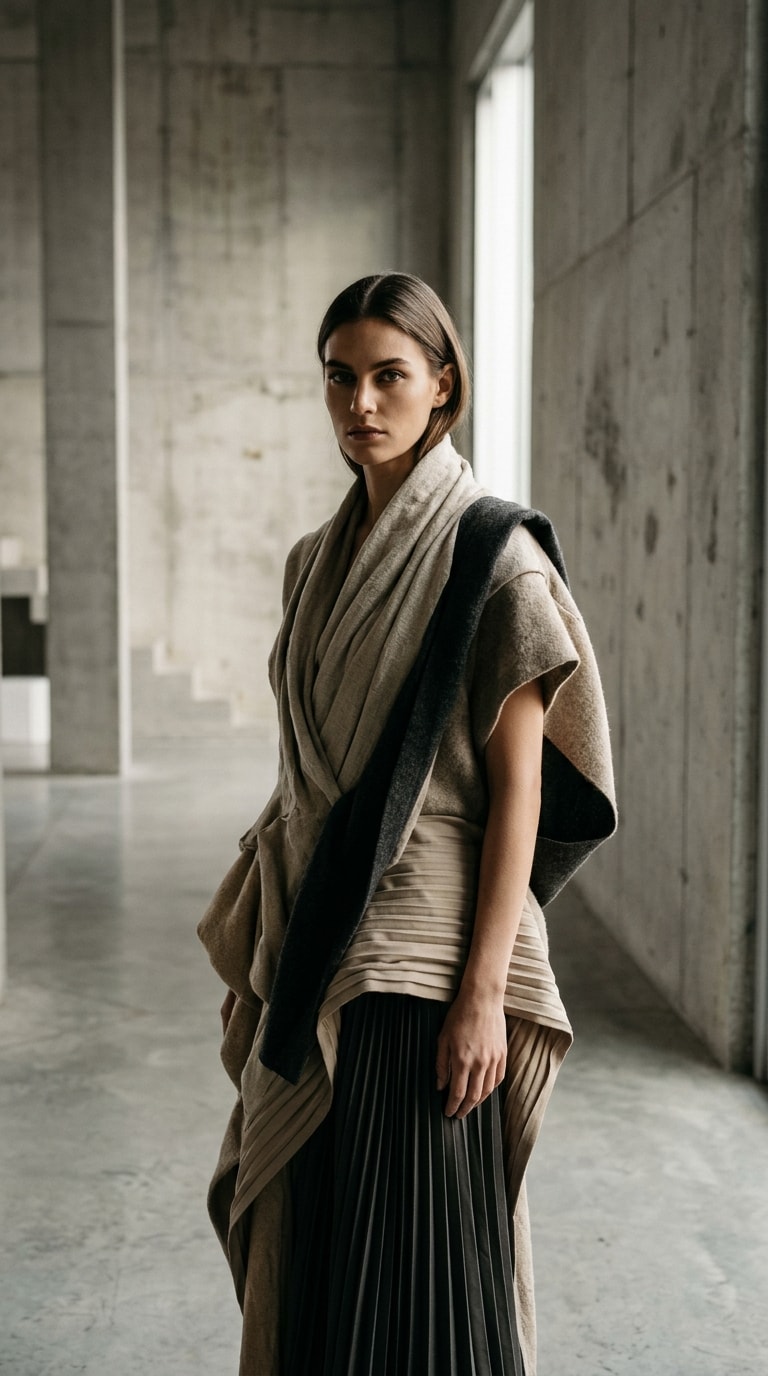
Some portraits are built on movement, on wind machines and mid-stride energy. This one is built on refusal. The model stands square to the camera, chin level, hair slicked back so tightly it reads as sculpture, and she gives the lens nothing but a stare. That restraint is the whole engine of the picture. In a portfolio full of motion, a frame where the subject simply holds still can feel louder than any gesture, because it asks the viewer to come closer instead of chasing the subject across the page.
The clothing rewards that stillness. A layered beige top with pleated, almost folded texture sits over a charcoal skirt, and a black sash cuts diagonally across the torso. Watch how the sash behaves: it is not decoration, it is a line. It breaks the vertical fall of the drape, gives the eye a path from shoulder to hip, and holds an otherwise soft silhouette together. When you style a muse, treat every added element as geometry first and ornament second. The pleats echo the fluting of the concrete column behind her, so outfit and room begin speaking the same language.
The location does half the work. Brutalist concrete, a polished floor, one tall narrow window. That window is the only real light source, and it arrives from the right, so shadows fall gently across the pleats and pick out the grain of the wall. Nothing is filled in. The background blurs just enough, the compression of a longer lens at a moderate aperture, to keep the pillars present without letting them compete with her face. Vertical lines everywhere: the window, the column edges, the fall of the skirt, even her posture.
Grey, taupe, black, and not much else. Restricting the palette to three neighbouring tones forces texture to carry the image. You read the fabric before you read the colour, which is precisely what you want when the clothes are architectural. For anyone assembling a portfolio, this is a repeatable recipe: one strong muse, one monochromatic wardrobe, one austere room, one direction of light, and a lens long enough to compress the space behind the subject.
What makes it a muse image rather than a clothing shot is the reciprocity. She is not wearing the building; she is answering it. Quiet power, held long enough to be photographed, and a reminder that the most memorable frame in a set is often the one where nobody moves at all.