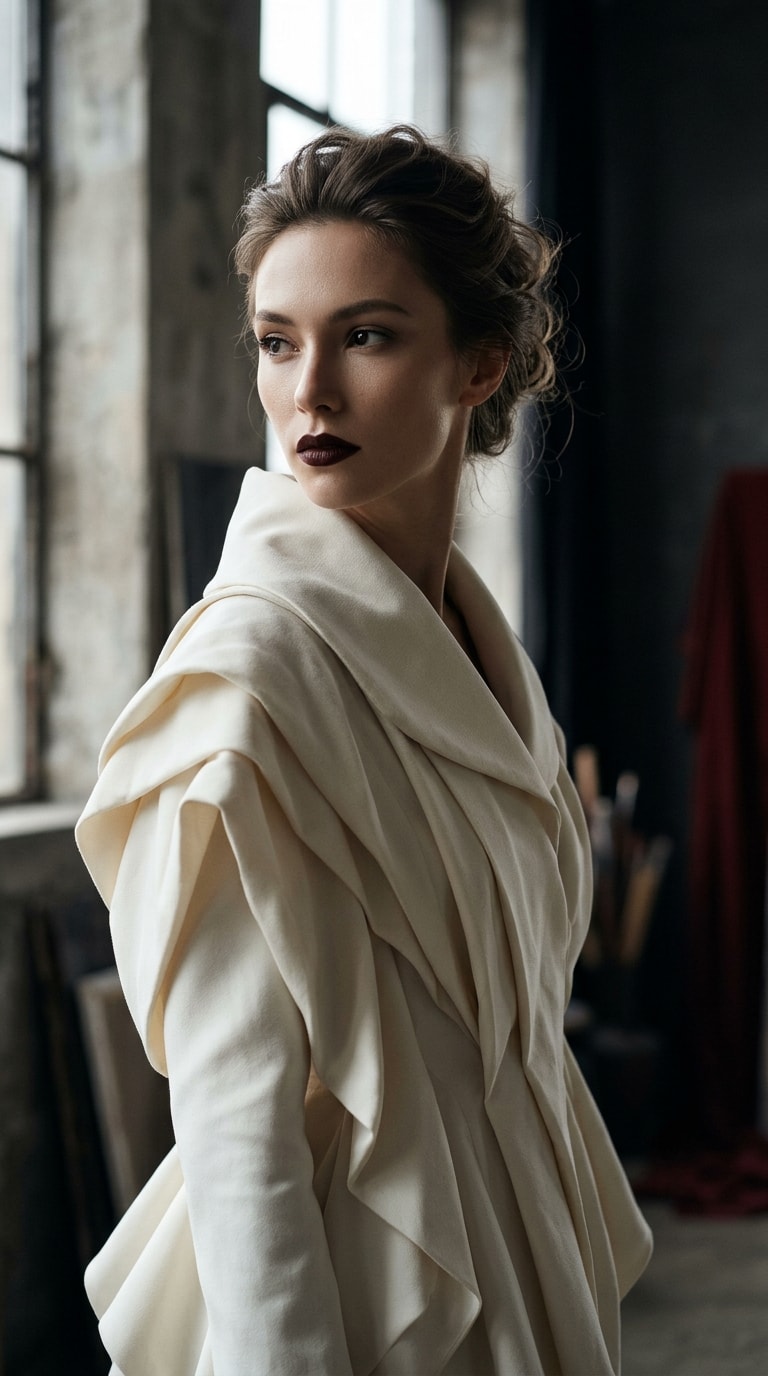
There is a moment in fashion when a garment stops behaving like clothing and starts behaving like architecture. The cream wrap in this portrait does exactly that: it folds and gathers into ledges and hollows, rising around the shoulders like something carved rather than sewn. Nothing about it is fussy. The volume is generous but controlled, each crease catching the window light on one side and dropping into shadow on the other. Against a concrete-gray studio, the ivory reads almost warm, and the eye keeps traveling the same path the fabric takes — up the shoulder, across the collarbone, into the soft hollow at the neck.
The restraint elsewhere is what makes the volume work. Hair is pinned into a loose, lived-in updo, a few strands escaping without apology. The lip is a deep plum, matte and deliberate, the only saturated note in an otherwise muted frame. No jewelry competes with the drape. No manicured gesture distracts from the gaze, which drifts off-camera as though the subject is listening to something the rest of us cannot hear. That single decision — looking away — is why the image feels introspective rather than presentational. She is not selling the dress. She is thinking in it.
Light does the heavy lifting. A large window to the left throws soft, directional daylight across the scene, and the falloff to the right is steep enough to sculpt cheekbones and deepen the folds of cloth. A medium telephoto lens compresses the space and blurs the industrial background into soft gray planes, with just a smear of deep red fabric lingering at the edge like a held breath. The crop is close, medium-close, close enough that texture becomes a subject in its own right: the weave of the ivory, the fine grain of skin, the faint sheen where light grazes the lipstick.
This is the quiet end of high fashion, and it is having a moment. After seasons of logos and loud styling, the pendulum has swung toward garments that ask to be looked at slowly — pieces with weight, with shadow, with a silhouette you can read from across a room. Draping is the oldest tool for that job, and the least forgiving; it exposes every shortcut in construction. When it is done well, as here, the result is reverie. You do not remember the trend. You remember the stillness.