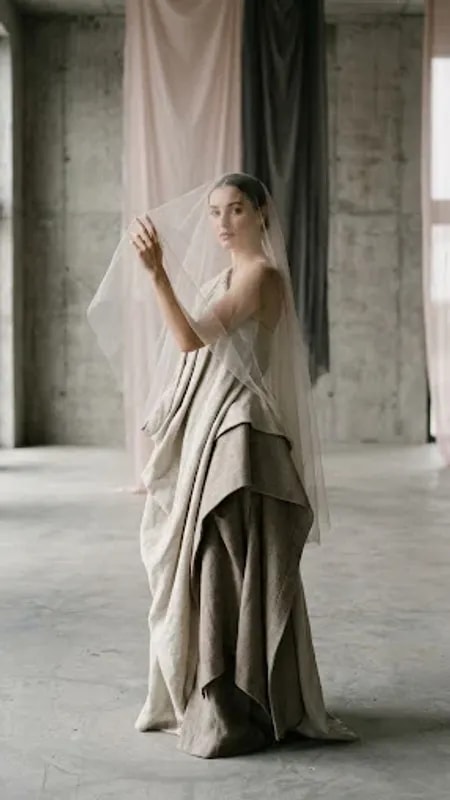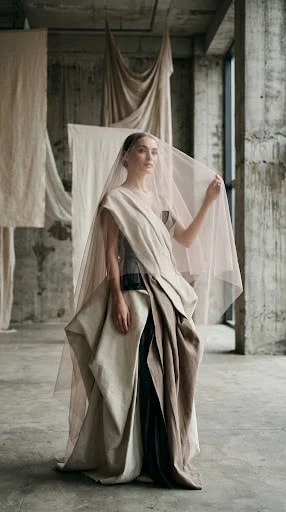
There is a particular kind of quiet that happens when a gown meets a bare concrete wall. In this frame, the room does almost nothing: gray floor, gray walls, a window on the right letting in a slow wash of daylight, and long swaths of textured fabric suspended from the ceiling like stage curtains left up between acts. Against all that hardness stands a single figure, centered and unhurried, holding a sheer white veil that frames her face. The contrast is the whole story. Muse core fashion lives in that gap between the industrial and the ethereal, where a soft thing becomes more powerful because of what surrounds it.
The gown itself is a study in controlled volume. Structured tailoring shapes the shoulders and bodice, then gives way to gathered, layered folds of beige and taupe, with a darker charcoal panel cutting through the drape. Nothing about it is printed or patterned; the interest comes entirely from how the fabric stacks, twists and falls. That is the discipline behind this aesthetic — texture over decoration, silhouette over trend. A single sculptural piece, cut with intention, reads louder in a muted palette than a dozen busy ones ever could.
Light does the rest. Because the daylight arrives diffused from one side, every fold carries a soft shadow and every shadow has a direction. The concrete is cool and flat; the cloth is warm and dimensional; the two keep correcting each other. Notice how the hanging fabrics in the background echo the gown's gathering without repeating it, so the whole room feels like an extension of the garment rather than a backdrop for it. This is the argument for photographing fashion in unfinished spaces: raw surfaces give soft fabric something to answer to.
The veil is the quietest gesture in the image and the most important. Sheer, white, held rather than worn, it introduces a translucent layer that softens the face without hiding it — a mood of romantic solitude, of someone caught mid-thought in the middle of making something. That held object is easy to borrow for your own styling: one pale, weightless accessory against earthy layers adds air to an otherwise heavy look.
If muse core fashion can be reduced to a working method, it is this. Keep the palette to creams, taupe, charcoal and cool gray. Choose one garment with real architecture. Add something sheer. Then find a room with concrete, high ceilings and a window, and stand still long enough for the light to do its work.