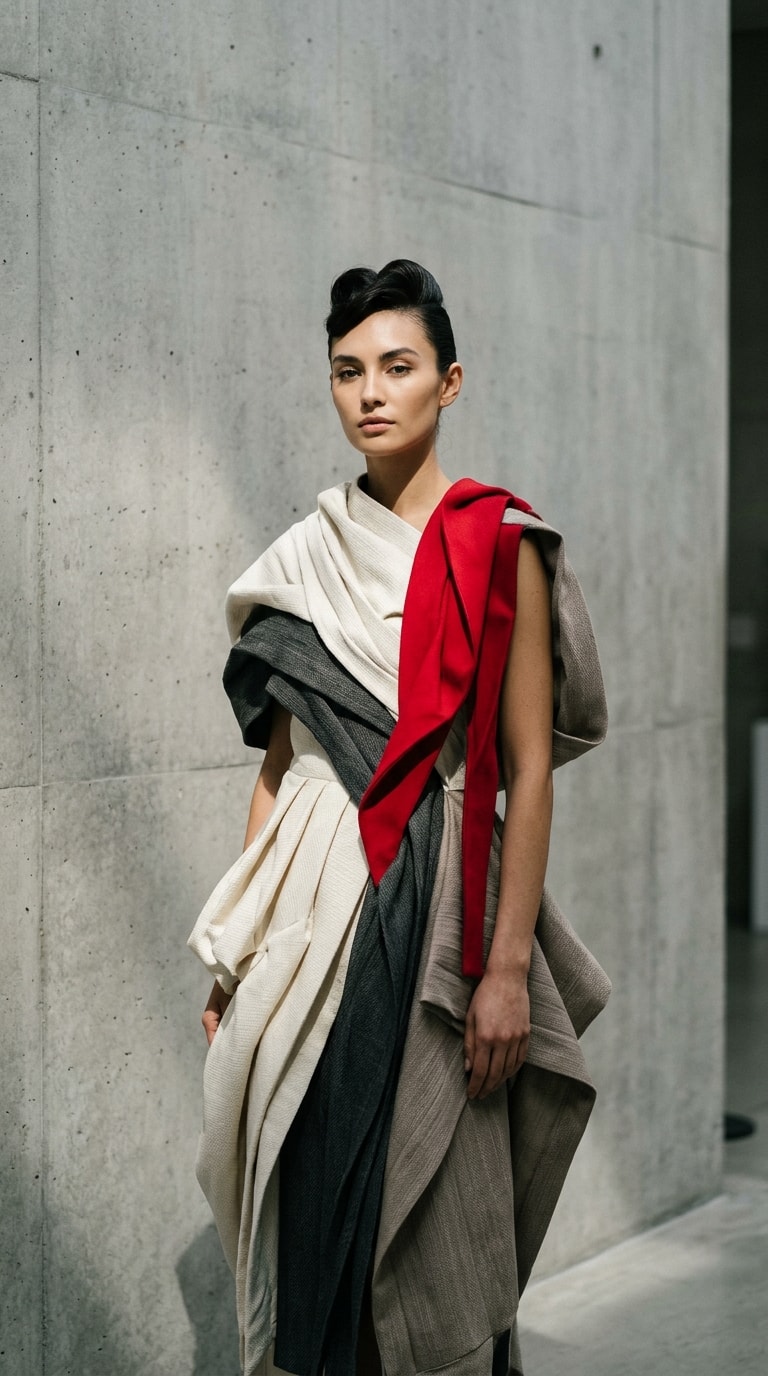
Most fashion portraits begin with the clothes. This one begins at the crown. The model's hair is built rather than styled — swept up and back into a rounded, almost helmet-like volume that sits above her forehead like a small monument. It reads as retro in its proportion and futuristic in its finish, a shape that could belong to a 1960s couture salon or a science-fiction runway fifty years from now. Either way, it does the quiet work that great styling always does: it gives the face a frame and the silhouette a roofline.
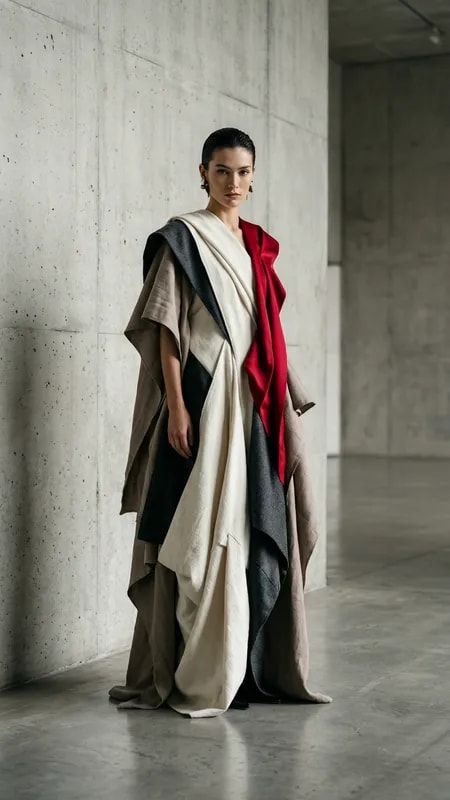
That roof matters because everything below it cascades. The ensemble is layered and heavy with fabric — pale cream draped against dark olive, wrapped and folded until the body becomes a series of soft geological strata. Without the taut, disciplined shape at the top, all that volume would sag into shapelessness. The updo is the anchor point, the hard edge that lets the softness underneath feel intentional. Notice how the directional light catches the curve of the hair first, then travels down through the folds, tracing the same path a viewer's eye takes. The styling is doing narrative work, not decoration.
Then there is the gaze. She looks straight out, unsmiling, and the height of the hair pushes the eyes into the lower third of the frame, which makes the stare land harder. There is nowhere else to look. Photographers often talk about the importance of a subject's eyes, but here the architecture above the eyes is what gives them their force — the same way a low ceiling makes a room feel intense. The blank concrete wall behind her, textured and unremarkable, refuses to compete. It is negative space in the most literal sense, and it lets the sculpted head read as the single deliberate object in an otherwise austere field.
For anyone building a fashion muse page, the lesson is not to save all the drama for the garment. Hair and headwear can carry a portrait's structure, especially when the clothing is draped, layered, and soft. Give the silhouette a hard point, keep the background quiet, and let the light descend from that point downward. The result is a portrait that feels less like a model wearing clothes and more like a figure constructed on purpose — austere, expressive, and impossible to scroll past.