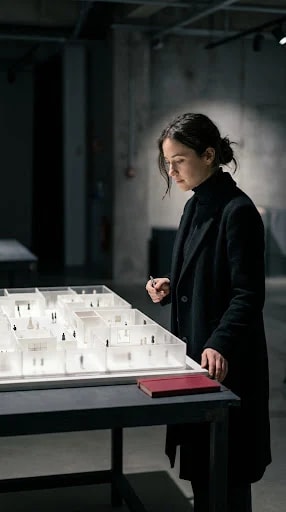
The model is the easy part to photograph. White foam core, cut clean, walls standing at their proper height, a staircase folded into the corner like a held breath. It sits under directional light on a black table, and from the right angle it looks finished, resolved, almost smug. The woman leaning over it knows better. She has been circling this table for an hour, and the only object on it with any color is the notebook she keeps returning to.
That red book is where the real floor plan lives. Inside are the notes the model refuses to show: the wall that has to move forty centimeters because a nineteenth-century court train needs room to turn, the case depth that looks generous on paper and cramped once a bodice is mounted on a form, the corridor that photographs beautifully and bottlenecks on a Saturday. A model is a proposition. A notebook is an argument with it. Curators who plan fashion exhibitions learn to keep both open at once, because garments are not paintings. They have volume, weight, and a tendency to demand air on every side.
Watch her hands and you can read the method. She leans in, sightline level with the model's floor, checking what a visitor will actually see when they step through the entry. Fashion displays fail most often at eye level and below: hems lost behind a plinth, shoes sunk into shadow, a sleeve that disappears into a corner. So she crouches, tilts, measures with a pencil held at arm's length. Then she writes. Each note is a small correction, and each correction ripples — move one partition and the lighting track shifts, the label rail shifts, the guard's path shifts.
The concrete pillars behind her are a useful reminder that this white geometry will land inside a building with its own opinions. Columns do not negotiate. Service doors open where they open. The model floats free of all that, which is precisely why the notebook exists: to drag the fantasy back into the room and mark where reality pushes through.
Later there will be renderings, schedules, a lighting designer with strong views. For now there is a woman, a lamp, a white plan, and one red book holding the questions. When the exhibition finally opens, no visitor will see any of this. They will walk the route she traced, pause where she paused, and find the dress waiting at the exact distance she chose.