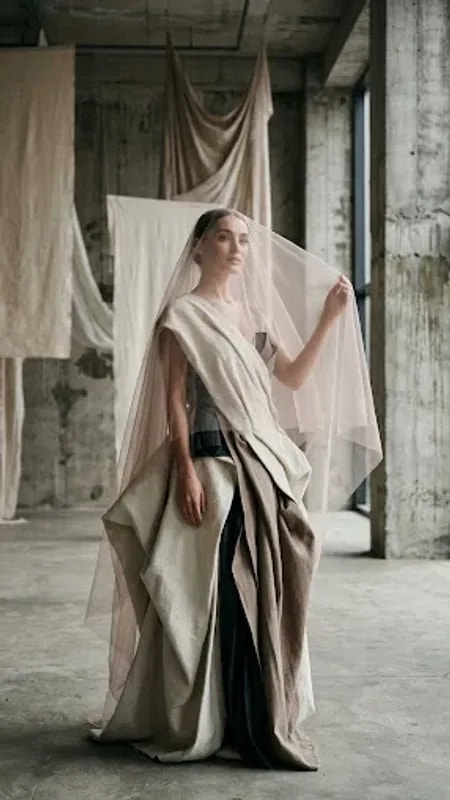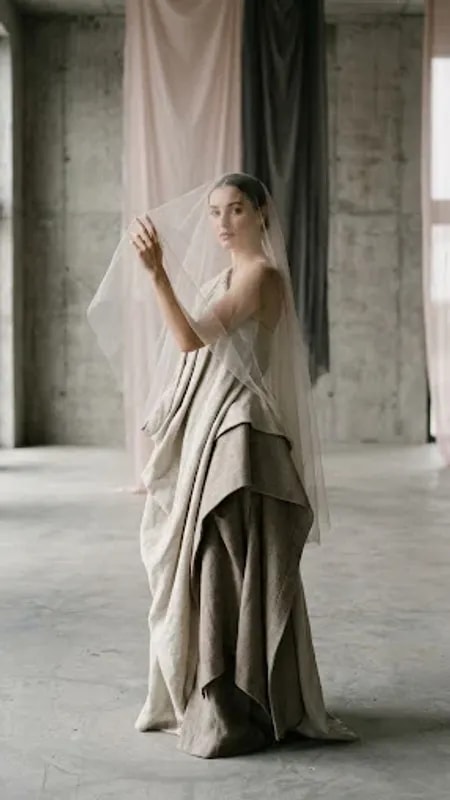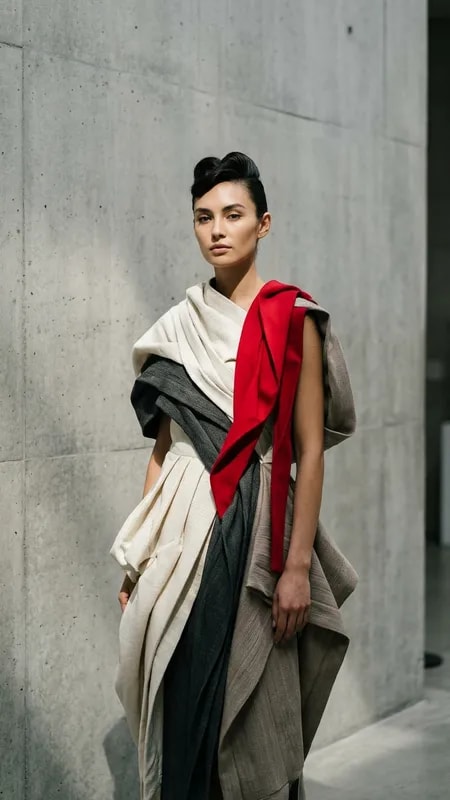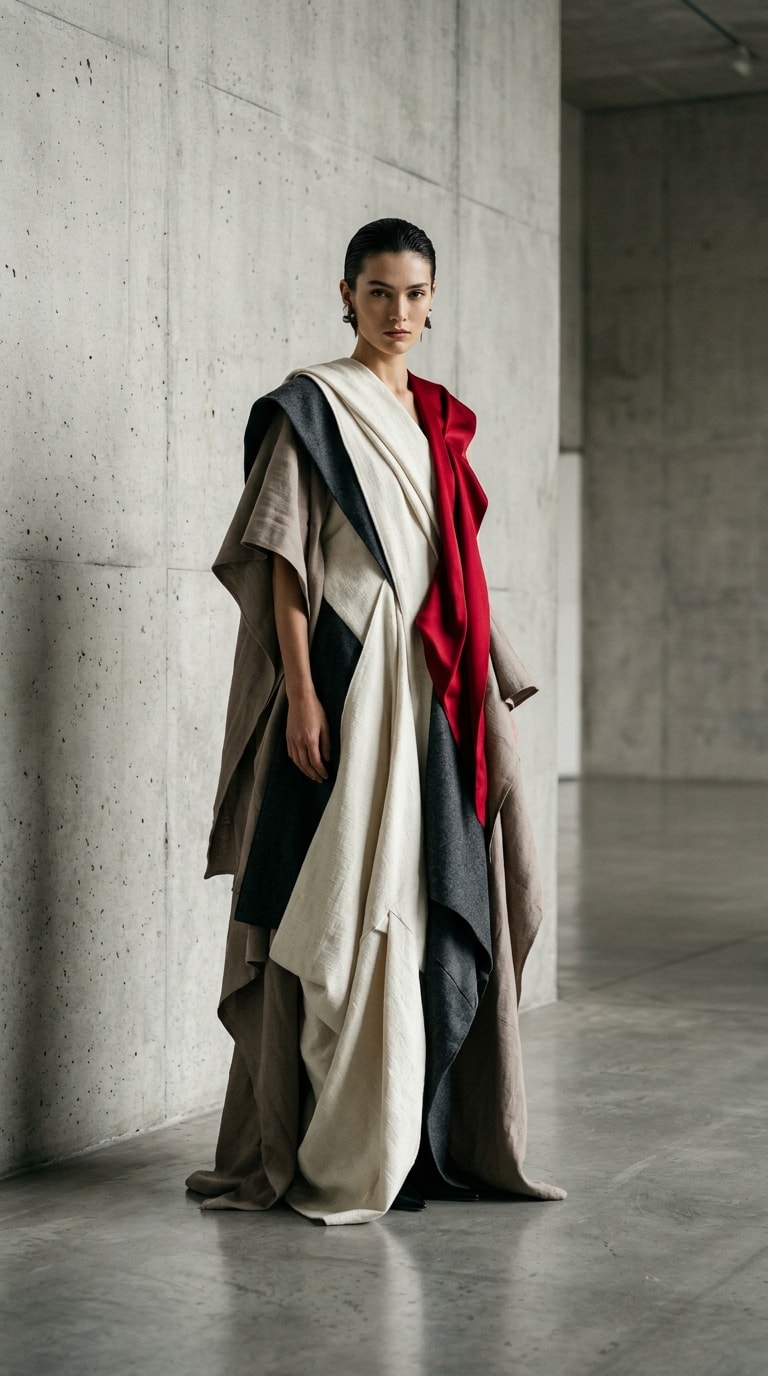
There is a particular kind of confidence that does not announce itself. It stands in a room of raw concrete, wrapped in meters of linen that fold and fall like architecture, and simply looks at you. That is the mood of this editorial: a model framed slightly off-center against a vast, textured wall, her garment doing most of the talking while her gaze holds the frame together. Nothing here is loud except one thing, and that thing is red.
The garment itself is the story. Layers of taupe, cream, and black fabric are cut and draped until they read less like clothing and more like a structure built around a body. Volume is stacked on volume, yet the silhouette never feels heavy, because the layers are arranged with a kind of deliberate geometry — wide at the shoulder, gathered at the waist, spilling toward the floor. This is the difference between wearing fabric and wearing form. A fashion muse understands that distinction instinctively, and knows when to let the clothes perform while she supplies the stillness.
Then there is the crimson accent at the neck. One vivid note in a palette of restrained neutrals, it changes everything. Without it, the image would be a study in tone and texture, elegant but safe. With it, the eye has somewhere to land, and the whole composition gains a pulse. This is the oldest trick in styling and still the most effective: build a quiet, disciplined foundation, then interrupt it once, decisively. The red does not match anything. That is precisely why it works.
The setting does half the work. Brutalist concrete is unforgiving — it flattens soft light, exposes every wrinkle, and offers no decoration to hide behind. Soft directional light from one side carves the folds of the fabric into ridges and shadows, and the polished floor throws back just enough reflection to keep the image from feeling cold. Placing the figure off-center against all that negative space gives her room to breathe and gives the viewer room to look. Restraint, in both the styling and the framing, is what makes the image linger.
What makes a muse is not beauty alone but the ability to hold a room without raising a voice. Here, that means a steady gaze, a stillness in the shoulders, and a willingness to disappear slightly into the cloth so that the cloth can speak. Copy the formula and you have a shoot: one strong silhouette, one deliberate color interruption, one hard, honest backdrop, and a subject who trusts the frame enough to stop performing. The result is avant-garde and minimal at once — and quietly unforgettable.