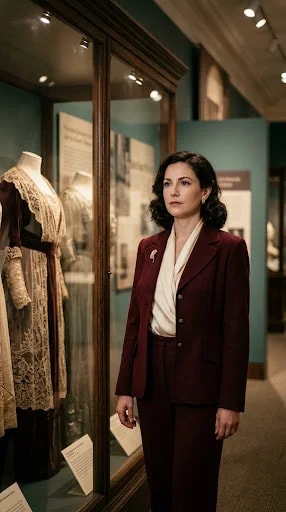
A costume gallery asks something unusual of its visitors. Most museum rooms want you to look at an object and learn its date, its maker, its provenance. A fashion exhibit wants you to imagine a body inside the object, moving through a room, sitting down carefully, sweating in August. The cream lace dress behind the glass, with its dark velvet accents, is not only a garment from a particular decade. It is a record of how one woman arranged her day around what she was wearing.
For a long time, dress collections sat at the edge of women's history museums, treated as decorative rather than documentary. That has changed. Curators now read a bodice the way they read a letter: seam allowances show budget, alterations show a garment passed down or let out during a pregnancy, a repaired hem shows thrift, a stain shows a meal that was eaten. Lace is especially talkative. It took hours to make, it could not be washed easily, and it signaled occasion. A woman who owned a lace gown owned a narrow slice of her own calendar, reserved for weddings, christenings, and photographs.
What makes this room work is the pairing. The visitor in the tailored burgundy suit is not a mannequin and not a curator in a white coat. She is a living counterpoint, dressed with the same deliberateness as the dress in the case. Her small brooch and cream blouse answer the lace across the gap of a century, and the teal walls and warm track lighting hold both in one frame. The glass reflects her slightly, so the two figures overlap for a moment. That overlap is the whole argument: fashion history is not a shelf of curiosities, it is a continuous conversation about how women present themselves in public and what that presentation costs.
On the interpretation panels nearby, small labels do the quiet work of naming the wearer, the occasion, the fabric, the donor. Those names matter. So often the genius of a dress survives while the woman who wore it is filed as anonymous. Exhibits like this one push back, restoring a person to the garment and a garment to the person.
The best way to see a show like this is slowly, and then to look down at your own sleeves on the way out. Every visitor is wearing an artifact in progress, and it is already telling the room something.